In two recent editions of this publication, I have described the work of Dr. Norman E. Borlaug and colleagues at the International Maize and Wheat Improvement Center (CIMMYT) and what is commonly referred to as the Green Revolution. I have also addressed
some of the criticisms and allegations that Borlaug’s work created environmental problems and what is often referred to as the Blue Revolution.
The basic framework of my argument is strongly supported by classical agronomy, crop physiology, and ecology. While different authors may organize the concepts somewhat differently, the combination of solar radiation, water, nutrients, and genetics are
the principal determinants of crop productivity. There is a strong foundation in relevant literature regarding this understanding of soil-plant-water relations.
The basic framework of limiting factors as I have previously presented in simplified form is consistent with classical agronomy, crop and soil science. Where crop productivity depends on these first four limiting factors:
The following references are among the most authoritative sources supporting this framework.
1. Monteith's Framework: Radiation Interception and Conversion Efficiency
Perhaps the most influential quantitative framework was developed by John Lennox Monteith. Monteith demonstrated that crop biomass production can be described as a function of:
This work established solar energy capture as the fundamental driver of crop productivity.
Key reference
Monteith J.L. 1977. Climate and the efficiency of crop production in Britain. Philosophical Transactions of the Royal Society of London B. 281:277–294.
2. de Wit and Yield Potential Theory
Cornelis de Wit developed the concept of potential production, water-limited production, and nutrient-limited production. His framework remains foundational in crop modeling, soil fertility,
and other agronomic applications.
de Wit made the following distinctions:
This closely parallels the hierarchy of limiting factors as I have presented them.
Key reference
de Wit C.T. 1958. Transpiration and Crop Yields. Wageningen, The Netherlands: Institute of Biological and Chemical Research on Field Crops and Herbage.
3. Classical Crop Physiology
The textbooks of Donald N. Moss, Paul J. Kramer, and later Robert M. Peet each emphasize that crop growth depends fundamentally on:
These texts describe genetics as determining the plant's capacity to utilize resources and partition biomass into economic yield.
4. Sinclair and Muchow
Thomas R. Sinclair and colleagues developed influential analyses showing that crop yield is fundamentally constrained by:
Plant genetics determines how efficiently those resources are converted into harvestable yield.
Key reference
Sinclair T.R., R.C. Muchow. 1999. Radiation use efficiency. Advances in Agronomy. 65:215265.
5. Cassman and Yield Potential Analysis
Kenneth G. Cassman formalized modern yield-gap analysis. His work identifies three yield levels:
Ken Cassman and his colleagues have done a nice job outlining how genetics establishes yield potential, while water and nutrients determine how much of that potential can be realized.
Key reference
Cassman, K.G. 1999. Ecological intensification of cereal production systems: Yield potential, soil quality, and precision agriculture. Proceedings of the National Academy of Sciences. 96:5952–5959.
Lobell, D.B., K.G. Cassman, and C.B. Field. 2009. Crop yield gaps: Their importance, magnitudes, and causes. Annu. Rev. Environ. Resour. 34:179–204.
6. Evans' Comprehensive Treatment
A particularly strong source supporting my overall interpretation is the work of Lloyd T. Evans. Evans argued that crop productivity results from interactions among:
Much of the twentieth century's yield growth arose from genetic improvements that allowed crops to make more effective use of available resources. The CIMMYT program directed by Dr. Borlaug is a great example of this.
Key reference
Evans, L.T. 1993. Crop Evolution, Adaptation and Yield. Cambridge, UK: Cambridge University Press.
A concise summary of the classical agronomic view holds that crop productivity is determined by the capture of solar energy through photosynthesis, constrained by the availability of water and essential nutrients, and ultimately expressed through the
genetic capacity of the crop to convert acquired resources into economically useful yield (Lobell et al., 2009).
This is consistent with the work of de Wit, Monteith, Evans, Sinclair, Cassman, and many other leading crop physiologists and agronomists. It also provides a strong scientific basis for the earlier argument regarding the Green Revolution: the principal innovation was genetic improvement, while irrigation and fertilization functioned primarily to remove environmental constraints and support more complete expression of genetic yield potential.
References
Cassman, K.G. 1999. Ecological intensification of cereal production systems: Yield potential, soil quality, and precision agriculture. Proc. Natl. Acad. Sci. USA 96:5952–5959.
de Wit, C.T. 1958. Transpiration and crop yields. Wageningen, The Netherlands: Institute of Biological and Chemical Research on Field Crops and Herbage.
Evans, L.T. 1993. Crop evolution, adaptation and yield. Cambridge (UK): Cambridge Univ. Press.
Lobell, D.B., K.G. Cassman, and C.B. Field. 2009. Crop yield gaps: Their importance, magnitudes, and causes. Annu. Rev. Environ. Resour. 34:179–204.
Monteith, J.L. 1977. Climate and the efficiency of crop production in Britain. Philos. Trans. R. Soc. Lond. B Biol. Sci. 281:277–294.
Sinclair, T.R. and R.C. Muchow. 1999. Radiation use efficiency. Adv. Agron. 65:215–265

Galls observed on the stems of begonias submitted to the clinic
Recently, we received a submission of begonias to the Yuma Plant Health Clinic that immediately presented a diagnostic challenge. At first glance, the symptoms seemed to point toward a familiar set of suspects. The plants had developed severe swelling of the stems, symptoms characteristic of physiological oedema or bacterial Agrobacterium-associated crown gall. But, as is often the case in plant diagnostics, appearances can be deceiving.
The begonias had been grown indoors in high-humidity terrariums and planter boxes. The symptoms were not associated with a particular begonia variety, nor were they consistently expressed across all plantings or cuttings. When the plants were removed from their planting substrate, however, another clue emerged: additional small galls were scattered throughout the root systems of those plants also showing the stem swellings. That observation changed the diagnostic picture considerably.

Galls observed on the roots of begonias submitted to the clinic
Dissection of both the swollen stem tissue and the roots revealed an abundance of eggs, juveniles, mature female nematodes, and giant cells, a classic signature of root-knot nematode (RKN) infection. Root-knot nematodes belong to the genus Meloidogyne, a group of microscopic roundworms that are among the most important plant-parasitic nematodes worldwide. Their typical symptom is familiar to many resulting in the formation of characteristic galls on roots.
These galls are not simply a physical wound created by the nematodes. Rather, RKNs actively manipulate their host. During infection, the nematodes secrete salivary compounds that alter plant growth and development, effectively hijacking normal cellular processes and redirecting them toward the formation of specialized feeding structures known as giant cells.
These giant cells become a nutrient-rich feeding site for the developing and mature nematodes. In doing so, the nematode establishes a sustained drain on the plant's resources. As infection progresses, the resulting disruption to the root system can interfere with nutrient acquisition and water uptake. Aboveground, this typically translates into stunted growth, declining foliage, wilting, and, in severe infestations, plant death. With more than 3,000 plant species reported as hosts to different root-knot nematode species worldwide, including many field and vegetable crops, the annual impact of these pathogens is enormous. Much research has been done on RKN in various crops, and reports of stem swellings occurring naturally is almost non-existent.
Yet the begonia case raises an especially interesting question: Why did a pathogen best known for producing root galls appear to be responsible for such dramatic swelling in the stems? This is where the environment becomes an essential part of the diagnosis.
The symptom is not the pathogen. It is a reaction of the plant to the presence of a pathogen. One of the most important principles in plant pathological diagnostics is that the same pathogen does not necessarily produce the same symptom under every set of environmental conditions. Likewise, similar symptoms can arise from entirely different causes.
Temperature, humidity, water availability, substrate conditions, light, nutrition, plant age, and even the way a plant is cultivated can all influence how a disease develops and how its symptoms are expressed. In other words, the symptom we see is the product of an interaction between the host, the pathogen, and the environment. Change any one of those components, and the resulting disease can change dramatically. This recent begonia case is a particularly useful reminder of this principle.
Root-knot nematodes are well known for their belowground symptoms, but reports of rare and isolated cases of infections on aerial plant tissues, including stems, leaves, and flowers, are reported in only one publicly available extension bulletin from 1985. These symptoms remain unusual and have rarely been observed unless aerial tissues are artificially inoculated, and they have only been documented in a limited number of hosts.
So, when confronted with the unusual stem symptoms in a begonia, it would be easy to focus exclusively on the appearance of the tissue and pursue diagnoses such as oedema or crown gall. These plants were being cultivated in enclosed, high-humidity conditions, where moisture levels around the plant were substantially different from those experienced by a plant growing in a more open environment. Such conditions can alter transpiration rates, water movement, tissue hydration, pathogen development, and the plant's own physiological responses. They also give rise to the wet, humid conditions necessary for oedema to develop or crown gall bacteria to thrive.
The small root galls were an important clue. Microscopic examination then provided the confirmation: eggs, juveniles, mature females, and the characteristic giant cells associated with root-knot nematode feeding. These signs of RKN were found in both the root and stem swellings. Understanding the environment in which the hosts were being grown, with its high moisture conditions, then provided supporting evidence that the nematodes had favorable environmental conditions to migrate into much higher foliar tissues than is typically seen in RKN infestations and produce an unusual symptom. Swollen galls on the stem told us that something was wrong, and if we relied on the most common culprits associated with this symptom alone, namely oedema or crown gall, we would have gotten the diagnosis wrong.
The begonia case is a fascinating example of how flexible disease expression can be. A pathogen with a reputation for being almost exclusively soilborne and producing galling symptoms on root tissues, under particular host and environmental circumstances, can be associated with symptoms in tissues where we do not ordinarily expect to find them.
Ultimately, environment is not simply a backdrop against which plant disease occurs. It is one of the determinants of how disease develops, how severe it becomes, and critically for anyone trying to ID the pathogenic cause, what it looks like.
If you have any concerns regarding the health of your plants/crops please consider submitting samples to the Yuma Plant Health Clinic for diagnostic service or booking a field visit with me:
Christopher Detranaltes, Ph.D.
Cooperative Extension – Yuma County
Email: cdetranaltes@arizona.edu
Cell: 602-689-7328
6425 W 8th St Yuma, Arizona 85364 – Room 109
Interested in ag tech? There are a couple of events you won’t want to miss. The first is the Automated Thinning & Weeding Technologies Round-Up being held TOMMOROW, Thursday, November 13th at the Yuma Agricultural Center. As the event name implies, this field day will showcase the latest technologies in automated thinning and weeding equipment operating in the field.
The motivation behind this event is that since last season, there have been several new developments in commercial automated thinning and weeding technologies. Companies that focused primarily on weeding with lasers or spot sprayers have developed new algorithms and/or improved precision so that the machines can now also be used for thinning lettuce. Significant enhancements have also been made to existing lettuce thinning machines that use AI to differentiate between lettuce plants and weeds including improved speed, durability and the ability to spot spray inter-row weeds.
For this year’s field day, we’ve added a twist we think you’ll like. The demos will be at the field scale level (> 1 acre), and most will be 20 minutes long. Approximately one half of the plot will be thinned prior to the event so that attendees can see the end result of the treatment. The other half of the plot will be used for live demonstrations on the day of the event. This format allows attendees to more fully evaluate machine performance and spend time with company representatives.
Registration begins at 7:00 am, breakfast will be served at 7:30 am and the program starts at 7:40 am (agenda below). An abbreviated version of the program will be repeated from 1:00-3:00 pm.
The second event is the two-day Desert Difference: FarmTech Connect. The first day is field day that will be held in conjunction with the Automated Thinning & Weeding Technologies Round-Up. The field days complement each other in that different types of technologies will be displayed at each event. Additionally, abbreviated versions of the 3-hour programs will be repeated from 1-3 pm so you will have the opportunity to see both. The second day is a traditional conference with keynote speakers, lightning talks and a trade show. The conference portion of the event will be held Friday, November 14th at the Yuma County Fairgrounds Legacy Event Center. Details of the Desert Difference: FarmTech Connect conference can be found here.
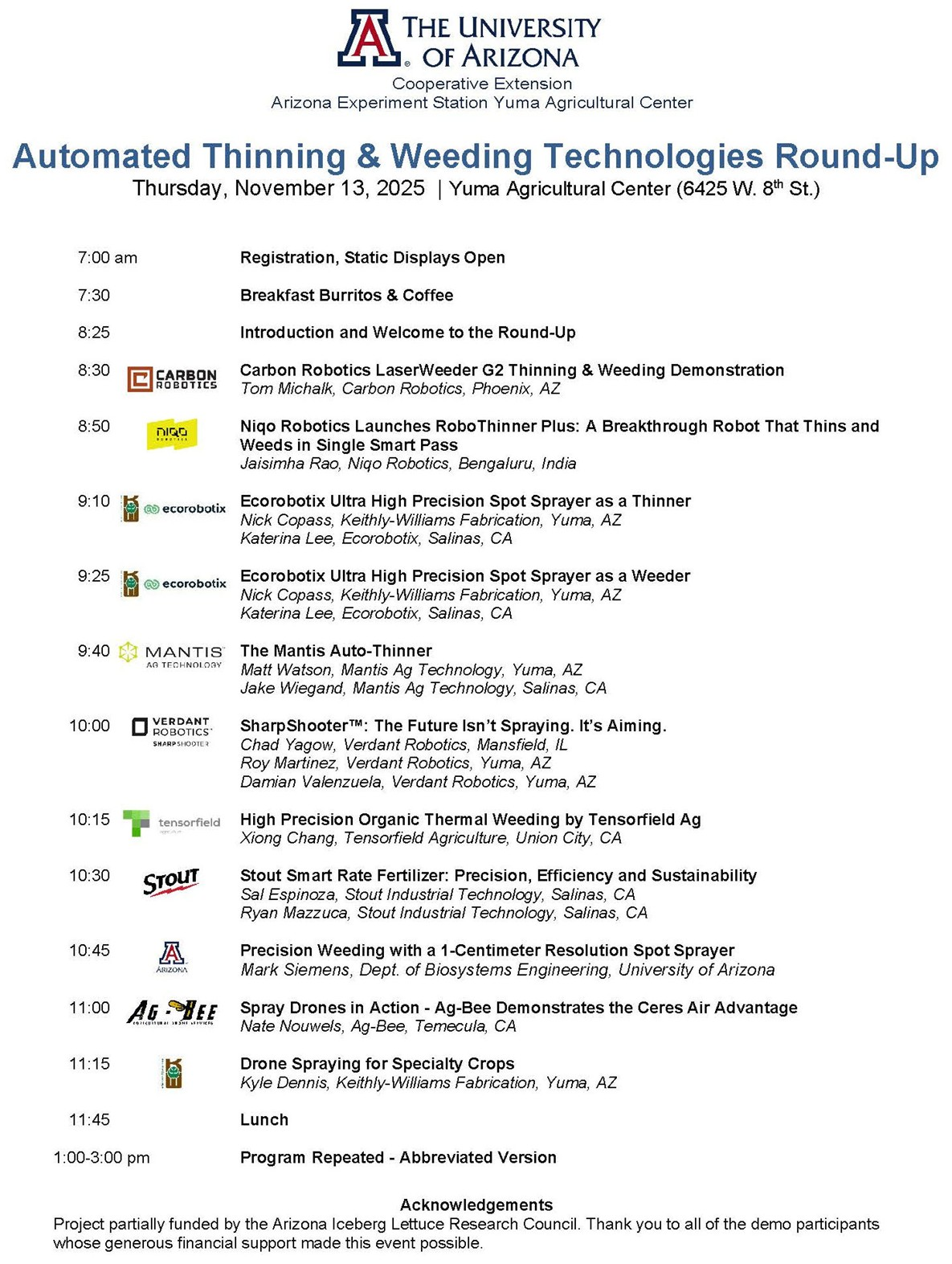
Fig. 1. Agenda for the Automated Thinning & Technologies field day. The event will be
held Thursday, November 13, 2025, at the Yuma Agricultural Center, 6425 W. 8th St.,
Yuma, AZ.

Fig. 2. Exhibitors and field day agendas for The Desert Difference: FarmTech Connect
and Automated Thinning & Weeding Technologies concurrent events being held
November 13, 2025, at the Yuma Agricultural Center, 6425 W. 8th St., Yuma, AZ.

Source: https://en.wikipedia.org/wiki/Spergularia_marina#/media/File:Starr_0806015237_Spergularia_marina.jpg
Recent reports from neighboring Imperial Valley, California indicate that Spergularia marina (sandspurry or saltmarsh sandspurry) is becoming an increasingly serious weed problem in alfalfa production. The species is well adapted to saline and alkaline conditions and can form dense, lowgrowing mats that persist beneath the alfalfa canopy. Given the similarities in climate, irrigation practices, and crop production systems between Imperial Valley and the Yuma area, we are interested in learning whether Arizona alfalfa growers are seeing this weed in their fields.
What Does Sandspurry Look Like?
Sandspurry is a low-growing, branching plant with narrow, fleshy leaves that can form dense mats in open areas. It is often associated with saline or poorly drained soils but may also be established
in irrigated agricultural fields. Early detection is important because small infestations can spread rapidly if left unmanaged.
Potential concerns for alfalfa production include:
In Imperial Valley, growers and crop advisors have reported increasing infestations and growing concerns about long-term management. While we do not yet know the extent of the problem in our local farms, early detection is important.
A Major Challenge: Limited Herbicide Options
One of the reasons sandspurry is attracting attention is the apparent lack of clearly effective, registered postemergence herbicide options specifically targeting this weed in established
alfalfa systems. As a result, management may rely heavily on:
We are particularly interested in hearing whether any currently registered alfalfa herbicides have provided acceptable suppression or control under the desert conditions.
We Need Your Input
If you grow alfalfa in Yuma County or elsewhere in southwestern Arizona, please let us know:
Why This Information Matters
Identifying new and emerging weed threats before they become widespread is a critical component of Integrated Pest Management (IPM). Information from you can help us determine:
Contact Us If you have seen sandspurry in your fields or have experience managing it, please share your observations. Photographs, field histories, and management experiences are especially valuable.
Your feedback will help us better understand the status of this weed in Arizona and develop practical recommendations for growers.
Integrated Pest Management (IPM) combines multiple compatible tactics to manage pests effectively and sustainably. Originally developed by entomologists in the 1950s and 1960s, IPM is now widely adopted by pest managers to address a range of pests, including
insects, weeds, and plant diseases. Most IPM tactics are compatible with both conventional and organic production systems.
In most production systems, no single management tactic provides complete or long-lasting pest control. The greatest success comes from combining multiple complementary tactics, resulting in more effective and sustainable pest management. This concept is often described as the “many little hammers” approach—each management tactic acts as a small hammer against the pest population, and together they provide meaningful suppression.
When developing an IPM program, it is important to prioritize planting resistant or tolerant crop varieties and adopt production practices that promote plant health and resilience. Additional strategies, such as physical, mechanical, and biological controls, can further reduce pest populations. Regular scouting is essential for monitoring pest levels, and economic thresholds can help guide decisions about when control actions may be necessary.

Figure 1. Illustration of common IPM tactics used in organic vegetable production.
IPM tactics commonly used in organic crop production
Organic crop production relies heavily on preventative and ecological pest management strategies. The following IPM tactics are commonly used in organic systems.
Resistant varieties
When available, resistant or tolerant crop varieties should serve as the first line of defense against pests. These varieties can reduce pest damage, lower production costs, and minimize environmental impacts associated with insecticide use.
Cultural control
Cultural practices modify the production environment, making it less favorable to pests. Examples include crop rotation, adjusting planting dates (early or late planting), selecting early-maturing varieties, and implementing systems such as trap cropping or push–pull strategies. These practices can reduce pest pressure and help protect crops from damaging infestations.
Scouting
Regular, timely scouting—at least once or twice per week during active crop growth—helps pest managers detect pest infestations early. Effective scouting helps ensure that control actions are taken only when necessary and prevents unnecessary pesticide applications.
Economic thresholds
The pest population or crop injury level at which control measures should be implemented to prevent economic loss. Used together with scouting, thresholds help determine when management actions are justified and can reduce unnecessary insecticide applications. This approach also helps mitigate the development of insecticide resistance.
Physical and mechanical control
Physical and mechanical tactics include installing physical barriers, tillage, and field sanitation. Removing volunteer plants and alternative hosts can reduce pest reservoirs. Tillage can also help suppress soil-dwelling pests by burying them, killing them directly, or exposing the pests to predators and environmental stresses.
Biological control
Biological control relies on natural enemies that attack pests. Important beneficial organisms include predators such as spiders, lady beetles, syrphid fly larvae, big-eyed bugs, minute pirate bugs, and lacewing larvae, as well as parasitoids such as parasitic wasps and flies. In desert vegetable systems, flowering field margins can help conserve natural enemies, such as lacewings, lady beetles, syrphid flies, and parasitoid wasps, which suppress aphid and other pest populations.
Bioinsecticides
Bioinsecticides are products derived from natural sources such as botanical extracts, fungi, bacteria, or viruses. These products can provide effective pest suppression while remaining compatible with organic production. Common examples include bacterial products such as Bt (Dipel, XenTari, Agree) and spinosad (Entrust, Seduce); botanical products such as pyrethrins and azadirachtin (Pyganic, Neem-based products); and fungal products such as Beauveria bassiana (BotaniGard).
Conclusion
Successful pest management requires combining multiple tactics rather than relying on a single solution. By integrating resistant varieties, cultural practices, scouting, biological control, and bioinsecticides, growers and PCAs can develop effective pest management programs that support both crop productivity and environmental sustainability.
Yuma agriculture is often described by its winter vegetable production numbers, but the deeper story is the management system behind those numbers. The Yuma region produces roughly 90% of the leafy greens grown in the United States during the winter season, and according to the U.S. Department of Agriculture Economic Research Service, from mid-November through early April, most lettuce sold in the country is sourced from the irrigated desert valleys of the Yuma area and California’s Imperial County (USDA ERS, 2023). That success is not because the desert is easy. It is because Yuma growers farm with precision in a place where rainfall is limited, sunlight is abundant, and irrigation management carries the crop. In this environment, water is not used only to meet crop demand; it also governs the movement of salts, nutrients, and moisture through the bed and root zone. This makes salinity management one of the background forces shaping almost every production decision in desert vegetable systems.
Water and salts must be managed together because they move through the soil as one system. Irrigation water commonly contains dissolved salts, and because evapotranspiration removes water while leaving those salts behind, repeated irrigation can concentrate salts in the root zone when they are not moved below it. Salinization is a long-recognized constraint on irrigated agriculture, particularly in arid and semi-arid regions where rainfall is not sufficient to flush salts from the soil profile. In desert vegetable fields, some irrigation beyond crop water use is therefore needed to move salts below the active root zone, but that water must be managed carefully. Too little leaching allows salts to concentrate near roots and reduce water uptake; too much irrigation wastes a limited supply and can carry nutrients below the root zone. The leaching requirement defines this balance: it is the minimum fraction of applied water that must drain below the root zone to keep soil salinity from reducing crop yield.
General salinity management starts with knowing where the salts are and what kind of salt problem exists. Soil and irrigation-water testing should track electrical conductivity, sodium adsorption ratio, pH, chloride, bicarbonate, calcium, magnesium, and sodium. If the problem is mainly soluble salts, the primary approach is controlled leaching with adequate drainage to move salts below the active root zone. If the problem is sodicity, in which sodium degrades soil structure and reduces water infiltration, calcium-based amendments such as gypsum may be needed to replace sodium on the soil exchange complex before leaching.
Soil structure is itself part of salinity management. High exchangeable sodium can disperse soil particles, reduce pore space, limit oxygen movement, and restrict water infiltration. This dispersion and aggregate breakdown can lower oxygen availability in the root zone and constrain plant productivity. Calcium amendments can improve aggregation and water movement where sodicity is present, but amendments alone do not remove salts. The displaced sodium and accompanying soluble salts still require water movement and drainage to leave the crop root zone. This is why desert farming is, at its core, root-zone management. The goal is not simply to apply more water, but to apply the right amount at the right time to support crop growth, maintain uniform moisture, protect nutrient availability, and prevent damaging salt accumulation. In Yuma, every irrigation decision is also a salinity decision. It affects where salts move, where roots grow, how nutrients remain available, and how uniformly the crop develops across the field.
Salinity also connects to IPM. Salts are not insects, weeds, or pathogens, but salinity is an abiotic stress that can weaken the crop. High root-zone salinity can reduce root growth, water uptake, nutrient balance, and plant vigor. A crop under this kind of stress may be less able to tolerate insect feeding, disease pressure, or weed competition, although the strength of that relationship varies with crop, pest, and growing conditions. In this sense, salinity management becomes part of preventive IPM: a healthy root zone gives the crop more capacity to withstand pest pressure.
Salinity management is not a single irrigation, amendment, or corrective action. It is a continuous production strategy that links irrigation scheduling, drainage, soil testing, nutrient management, and crop monitoring. In Yuma’s desert vegetable systems, managing salts before they become a visible crop problem helps protect stand uniformity, root function, water-use efficiency, and long-term soil productivity. Every irrigation moves water, but it also moves salts; understanding that movement is central to farming successfully in the desert.VegIPM Update Vol. 17, Num. 12
June 10, 2026
Results of sticky trap catches below!!
Whitefly: Adult activity remains steady across locations; above average for this time of the year. Historically, whitefly numbers peak in July.
Thrips: Adult thrips activity decreased across locations over the last two weeks. About average for this time of the year. Historically, western flower thrips numbers peak in May.