In two recent editions of this publication, I have described the work of Dr. Norman E. Borlaug and colleagues at the International Maize and Wheat Improvement Center (CIMMYT) and what is commonly referred to as the Green Revolution. I have also addressed
some of the criticisms and allegations that Borlaug’s work created environmental problems and what is often referred to as the Blue Revolution.
The basic framework of my argument is strongly supported by classical agronomy, crop physiology, and ecology. While different authors may organize the concepts somewhat differently, the combination of solar radiation, water, nutrients, and genetics are
the principal determinants of crop productivity. There is a strong foundation in relevant literature regarding this understanding of soil-plant-water relations.
The basic framework of limiting factors as I have previously presented in simplified form is consistent with classical agronomy, crop and soil science. Where crop productivity depends on these first four limiting factors:
The following references are among the most authoritative sources supporting this framework.
1. Monteith's Framework: Radiation Interception and Conversion Efficiency
Perhaps the most influential quantitative framework was developed by John Lennox Monteith. Monteith demonstrated that crop biomass production can be described as a function of:
This work established solar energy capture as the fundamental driver of crop productivity.
Key reference
Monteith J.L. 1977. Climate and the efficiency of crop production in Britain. Philosophical Transactions of the Royal Society of London B. 281:277–294.
2. de Wit and Yield Potential Theory
Cornelis de Wit developed the concept of potential production, water-limited production, and nutrient-limited production. His framework remains foundational in crop modeling, soil fertility,
and other agronomic applications.
de Wit made the following distinctions:
This closely parallels the hierarchy of limiting factors as I have presented them.
Key reference
de Wit C.T. 1958. Transpiration and Crop Yields. Wageningen, The Netherlands: Institute of Biological and Chemical Research on Field Crops and Herbage.
3. Classical Crop Physiology
The textbooks of Donald N. Moss, Paul J. Kramer, and later Robert M. Peet each emphasize that crop growth depends fundamentally on:
These texts describe genetics as determining the plant's capacity to utilize resources and partition biomass into economic yield.
4. Sinclair and Muchow
Thomas R. Sinclair and colleagues developed influential analyses showing that crop yield is fundamentally constrained by:
Plant genetics determines how efficiently those resources are converted into harvestable yield.
Key reference
Sinclair T.R., R.C. Muchow. 1999. Radiation use efficiency. Advances in Agronomy. 65:215265.
5. Cassman and Yield Potential Analysis
Kenneth G. Cassman formalized modern yield-gap analysis. His work identifies three yield levels:
Ken Cassman and his colleagues have done a nice job outlining how genetics establishes yield potential, while water and nutrients determine how much of that potential can be realized.
Key reference
Cassman, K.G. 1999. Ecological intensification of cereal production systems: Yield potential, soil quality, and precision agriculture. Proceedings of the National Academy of Sciences. 96:5952–5959.
Lobell, D.B., K.G. Cassman, and C.B. Field. 2009. Crop yield gaps: Their importance, magnitudes, and causes. Annu. Rev. Environ. Resour. 34:179–204.
6. Evans' Comprehensive Treatment
A particularly strong source supporting my overall interpretation is the work of Lloyd T. Evans. Evans argued that crop productivity results from interactions among:
Much of the twentieth century's yield growth arose from genetic improvements that allowed crops to make more effective use of available resources. The CIMMYT program directed by Dr. Borlaug is a great example of this.
Key reference
Evans, L.T. 1993. Crop Evolution, Adaptation and Yield. Cambridge, UK: Cambridge University Press.
A concise summary of the classical agronomic view holds that crop productivity is determined by the capture of solar energy through photosynthesis, constrained by the availability of water and essential nutrients, and ultimately expressed through the
genetic capacity of the crop to convert acquired resources into economically useful yield (Lobell et al., 2009).
This is consistent with the work of de Wit, Monteith, Evans, Sinclair, Cassman, and many other leading crop physiologists and agronomists. It also provides a strong scientific basis for the earlier argument regarding the Green Revolution: the principal innovation was genetic improvement, while irrigation and fertilization functioned primarily to remove environmental constraints and support more complete expression of genetic yield potential.
References
Cassman, K.G. 1999. Ecological intensification of cereal production systems: Yield potential, soil quality, and precision agriculture. Proc. Natl. Acad. Sci. USA 96:5952–5959.
de Wit, C.T. 1958. Transpiration and crop yields. Wageningen, The Netherlands: Institute of Biological and Chemical Research on Field Crops and Herbage.
Evans, L.T. 1993. Crop evolution, adaptation and yield. Cambridge (UK): Cambridge Univ. Press.
Lobell, D.B., K.G. Cassman, and C.B. Field. 2009. Crop yield gaps: Their importance, magnitudes, and causes. Annu. Rev. Environ. Resour. 34:179–204.
Monteith, J.L. 1977. Climate and the efficiency of crop production in Britain. Philos. Trans. R. Soc. Lond. B Biol. Sci. 281:277–294.
Sinclair, T.R. and R.C. Muchow. 1999. Radiation use efficiency. Adv. Agron. 65:215–265
Fusarium wilt of lettuce, caused by Fusarium oxysporum f. sp. lactucae (Fol), continues to be one of the most economically significant soilborne diseases affecting lettuce production. To date the most successful strategy for disease management, outside of preventing the introduction of the pathogen into new fields, has been the development and deployment of Fol resistant lettuce varieties. Resistant varieties carry genes which allow the lettuce to impede or respond to the pathogenic invasion through a defense response. The result of this interaction is often tolerance to the presence of the Fol, meaning genetically resistant varieties are still capable of getting infected but show less damage, form marketable heads more often, and may even slow the reproduction of the pathogen in the field.

Unfortunately, one size does not fit all. Each Fol resistance gene is not expected to be effective at defending against every isolate of Fol. When a new resistance gene is introduced into crop varieties, it imposes a strong selection pressure on Fol populations, favoring isolates that can overcome or evade the host’s genetic resistance. Put simply, isolates that are controlled by the resistance don’t reproduce, while random changes can allow other isolates to avoid detection and reproduce a lot. In some cases, change in just a single gene in the pathogen can cause a breakdown in varietal resistance and since fungi can mutate and reproduce much faster than we can breed new lettuce varieties, we are often on the losing end of this “arms race”. The progeny of isolates that overcome the resistance increase in frequency and eventually become predominant in the local pathogen population, ultimately resulting in declining performance of the resistant variety in the field.
For plant pathologists, geneticists, and breeders we need to have a way to describe and report this variation in response to different resistance genes. Hence breaking pathogens into “races” (also referred to as physiological races or pathotypes) is the practical way we capture the biologically meaningful variation within a single species of pathogen with regards to their ability to infect different varieties. A race is typically defined by what specific varieties it is able to cause disease on, and the panel of varieties with known resistance we use to determine races of a pathogen are called differentials. These differentials are a product of academic and industry breeding efforts to try to capture the most relevant patterns of disease susceptibility and pathogenicity that exists across commercial production environments.
Four races of Fol (designated 1, 2, 3, and 4) have been identified globally based on the ability to infect seven varieties. Race 1 was the first to be characterized and has been reported in the major lettuce-producing regions of Japan, Taiwan, the United States, and parts of Europe. It is as of yet the only race to have been reported in the United States. Resistance to race 1 has been successfully incorporated into many commercial lettuce varieties, and for years this provided control in affected areas.

However, in response to reports from Californian lettuce growers regarding abnormal disease patterns, namely increased susceptibility in race 1-resistant cultivars and reduced severity in susceptible cultivars, researchers also identified additional novel variant samples of Fol from California lettuce fields. Among them was the variant designated CR4 (named for its inability to cause disease on the differential variety ‘Costa Rica 4’) which was consistently able to exhibit a strong and unique pathogenicity pattern on the seven resistance differentials not matching any of the four previously known races. The researchers who discovered and characterized this new CR4 variant are now in the process of fulfilling the criteria necessary to have it internationally recognized as a new race. Until then, it is being referred to as a variant. Initially this variant was isolated from samples from coastal lettuce fields, however, occurrences across multiple fields and two non-adjoining counties (Monterey and Santa Barbara) indicated that it may have already spread across the major lettuce production regions of California and even Arizona as well. Since its discovery, CR4 was confirmed to be present in lettuce samples from Arizona by the same group who initially discovered it in California.
This lettuce season we’ve received some feedback concerning the possibility of race 1 resistance breakdown in lettuce in Arizona lettuce fields. It is not yet known in all of these cases if the infection of race 1-resistant material is due to CR4 variants that are evading race-1 resistance or if the abnormally warm and wet lettuce season made race-1 resistance look less effective than in past years, both of which are possible explanations this season. Determining this answer is made complicated by the pathotyping processes currently used to determine an Fol isolate’s race. It requires the precise inoculation of several different varieties under tightly controlled environmental conditions to see on which varieties the strain can and cannot induce disease. With Fol, this is further complicated by the need to designate intermediate reactions between complete susceptibility and resistance, which symptomatically can be difficult to reliably distinguish across pathotyping experiments.
However, researchers at the University of California led by Dr. Alexander Putman and in collaboration with the USDA-ARS are working on developing a DNA-based test that will be able to rapidly detect the Fol CR4 variant. The process bypasses the need for artificial inoculations and can be achieved much faster and more reliably than through inoculation-based methods. Updates on this exciting work will be featured in the plant pathology breakout session during this year’s Southwest Ag Summit. Be sure to drop by room AS112 on February 19th, from 1:30 – 3:30 pm to hear all about it!
Until then, while the CR4 variant does show the ability to evade the race 1 resistance bred into some varieties, it does not appear to be able to infect all lettuce varieties equally. In fact, it appears some varieties that have historically been susceptible to race 1 show increased resistance to the new variant, which is a promising sign that genetic resistance will remain available despite this pathogen’s shifting nature. The development of this DNA-based test will allow us to gauge the relative populations of each race across Yuma County and to tailor varietal recommendations depending on which race or variant is predominant in the field.
Recommended reading:
If you have any concerns regarding the health of your plants/crops please consider submitting samples to the Yuma Plant Health Clinic for diagnostic service or booking a field visit with me:
Christopher Detranaltes, Ph.D.
Cooperative Extension – Yuma County
Email: cdetranaltes@arizona.edu
Cell: 602-689-7328
6425 W 8th St Yuma, Arizona 85364 – Room 109
Interested in ag tech? There are a couple of events you won’t want to miss. The first is the Automated Thinning & Weeding Technologies Round-Up being held TOMMOROW, Thursday, November 13th at the Yuma Agricultural Center. As the event name implies, this field day will showcase the latest technologies in automated thinning and weeding equipment operating in the field.
The motivation behind this event is that since last season, there have been several new developments in commercial automated thinning and weeding technologies. Companies that focused primarily on weeding with lasers or spot sprayers have developed new algorithms and/or improved precision so that the machines can now also be used for thinning lettuce. Significant enhancements have also been made to existing lettuce thinning machines that use AI to differentiate between lettuce plants and weeds including improved speed, durability and the ability to spot spray inter-row weeds.
For this year’s field day, we’ve added a twist we think you’ll like. The demos will be at the field scale level (> 1 acre), and most will be 20 minutes long. Approximately one half of the plot will be thinned prior to the event so that attendees can see the end result of the treatment. The other half of the plot will be used for live demonstrations on the day of the event. This format allows attendees to more fully evaluate machine performance and spend time with company representatives.
Registration begins at 7:00 am, breakfast will be served at 7:30 am and the program starts at 7:40 am (agenda below). An abbreviated version of the program will be repeated from 1:00-3:00 pm.
The second event is the two-day Desert Difference: FarmTech Connect. The first day is field day that will be held in conjunction with the Automated Thinning & Weeding Technologies Round-Up. The field days complement each other in that different types of technologies will be displayed at each event. Additionally, abbreviated versions of the 3-hour programs will be repeated from 1-3 pm so you will have the opportunity to see both. The second day is a traditional conference with keynote speakers, lightning talks and a trade show. The conference portion of the event will be held Friday, November 14th at the Yuma County Fairgrounds Legacy Event Center. Details of the Desert Difference: FarmTech Connect conference can be found here.
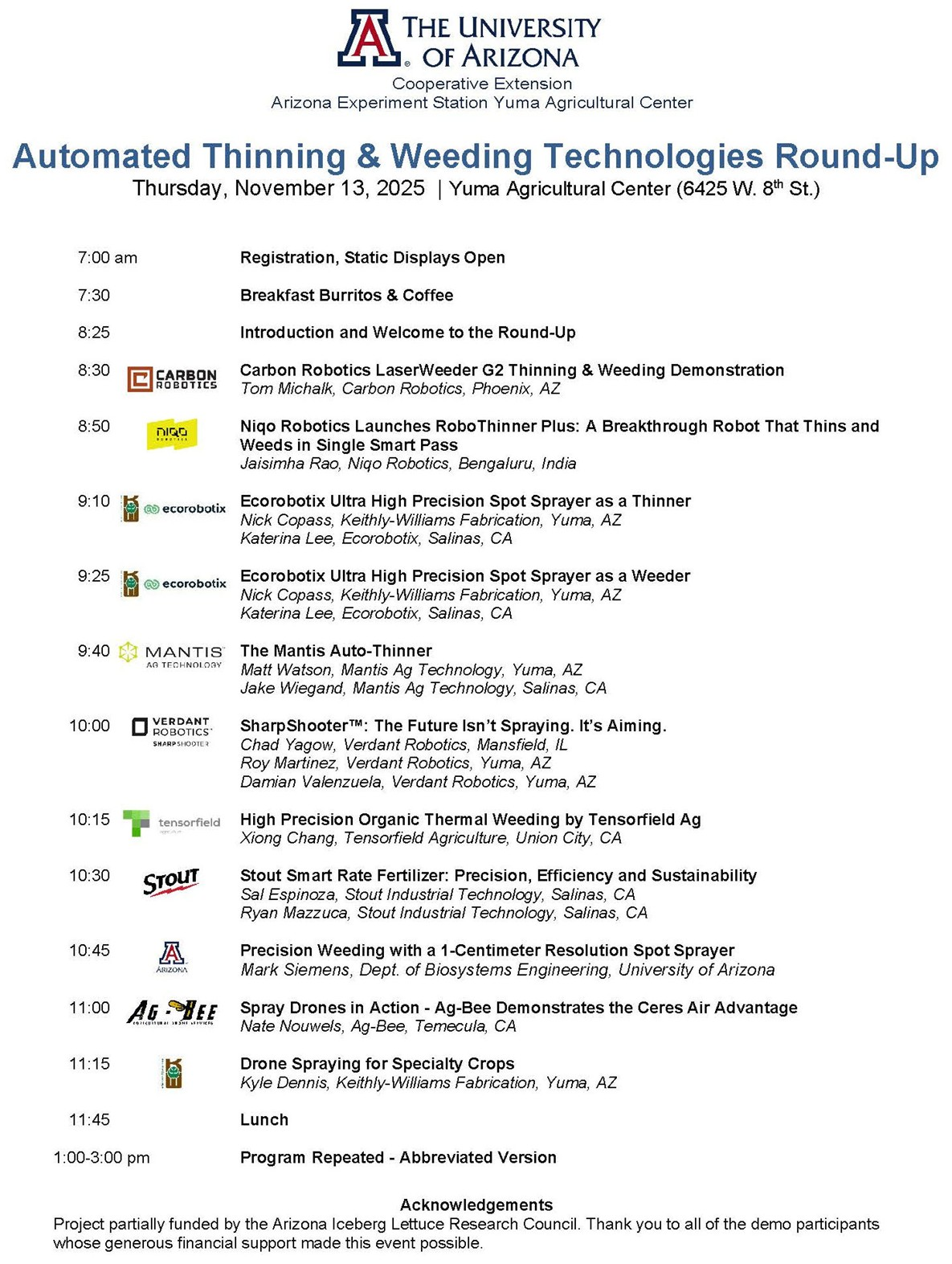
Fig. 1. Agenda for the Automated Thinning & Technologies field day. The event will be
held Thursday, November 13, 2025, at the Yuma Agricultural Center, 6425 W. 8th St.,
Yuma, AZ.

Fig. 2. Exhibitors and field day agendas for The Desert Difference: FarmTech Connect
and Automated Thinning & Weeding Technologies concurrent events being held
November 13, 2025, at the Yuma Agricultural Center, 6425 W. 8th St., Yuma, AZ.

Source: https://en.wikipedia.org/wiki/Spergularia_marina#/media/File:Starr_0806015237_Spergularia_marina.jpg
Recent reports from neighboring Imperial Valley, California indicate that Spergularia marina (sandspurry or saltmarsh sandspurry) is becoming an increasingly serious weed problem in alfalfa production. The species is well adapted to saline and alkaline conditions and can form dense, lowgrowing mats that persist beneath the alfalfa canopy. Given the similarities in climate, irrigation practices, and crop production systems between Imperial Valley and the Yuma area, we are interested in learning whether Arizona alfalfa growers are seeing this weed in their fields.
What Does Sandspurry Look Like?
Sandspurry is a low-growing, branching plant with narrow, fleshy leaves that can form dense mats in open areas. It is often associated with saline or poorly drained soils but may also be established
in irrigated agricultural fields. Early detection is important because small infestations can spread rapidly if left unmanaged.
Potential concerns for alfalfa production include:
In Imperial Valley, growers and crop advisors have reported increasing infestations and growing concerns about long-term management. While we do not yet know the extent of the problem in our local farms, early detection is important.
A Major Challenge: Limited Herbicide Options
One of the reasons sandspurry is attracting attention is the apparent lack of clearly effective, registered postemergence herbicide options specifically targeting this weed in established
alfalfa systems. As a result, management may rely heavily on:
We are particularly interested in hearing whether any currently registered alfalfa herbicides have provided acceptable suppression or control under the desert conditions.
We Need Your Input
If you grow alfalfa in Yuma County or elsewhere in southwestern Arizona, please let us know:
Why This Information Matters
Identifying new and emerging weed threats before they become widespread is a critical component of Integrated Pest Management (IPM). Information from you can help us determine:
Contact Us If you have seen sandspurry in your fields or have experience managing it, please share your observations. Photographs, field histories, and management experiences are especially valuable.
Your feedback will help us better understand the status of this weed in Arizona and develop practical recommendations for growers.
Integrated Pest Management (IPM) combines multiple compatible tactics to manage pests effectively and sustainably. Originally developed by entomologists in the 1950s and 1960s, IPM is now widely adopted by pest managers to address a range of pests, including
insects, weeds, and plant diseases. Most IPM tactics are compatible with both conventional and organic production systems.
In most production systems, no single management tactic provides complete or long-lasting pest control. The greatest success comes from combining multiple complementary tactics, resulting in more effective and sustainable pest management. This concept is often described as the “many little hammers” approach—each management tactic acts as a small hammer against the pest population, and together they provide meaningful suppression.
When developing an IPM program, it is important to prioritize planting resistant or tolerant crop varieties and adopt production practices that promote plant health and resilience. Additional strategies, such as physical, mechanical, and biological controls, can further reduce pest populations. Regular scouting is essential for monitoring pest levels, and economic thresholds can help guide decisions about when control actions may be necessary.

Figure 1. Illustration of common IPM tactics used in organic vegetable production.
IPM tactics commonly used in organic crop production
Organic crop production relies heavily on preventative and ecological pest management strategies. The following IPM tactics are commonly used in organic systems.
Resistant varieties
When available, resistant or tolerant crop varieties should serve as the first line of defense against pests. These varieties can reduce pest damage, lower production costs, and minimize environmental impacts associated with insecticide use.
Cultural control
Cultural practices modify the production environment, making it less favorable to pests. Examples include crop rotation, adjusting planting dates (early or late planting), selecting early-maturing varieties, and implementing systems such as trap cropping or push–pull strategies. These practices can reduce pest pressure and help protect crops from damaging infestations.
Scouting
Regular, timely scouting—at least once or twice per week during active crop growth—helps pest managers detect pest infestations early. Effective scouting helps ensure that control actions are taken only when necessary and prevents unnecessary pesticide applications.
Economic thresholds
The pest population or crop injury level at which control measures should be implemented to prevent economic loss. Used together with scouting, thresholds help determine when management actions are justified and can reduce unnecessary insecticide applications. This approach also helps mitigate the development of insecticide resistance.
Physical and mechanical control
Physical and mechanical tactics include installing physical barriers, tillage, and field sanitation. Removing volunteer plants and alternative hosts can reduce pest reservoirs. Tillage can also help suppress soil-dwelling pests by burying them, killing them directly, or exposing the pests to predators and environmental stresses.
Biological control
Biological control relies on natural enemies that attack pests. Important beneficial organisms include predators such as spiders, lady beetles, syrphid fly larvae, big-eyed bugs, minute pirate bugs, and lacewing larvae, as well as parasitoids such as parasitic wasps and flies. In desert vegetable systems, flowering field margins can help conserve natural enemies, such as lacewings, lady beetles, syrphid flies, and parasitoid wasps, which suppress aphid and other pest populations.
Bioinsecticides
Bioinsecticides are products derived from natural sources such as botanical extracts, fungi, bacteria, or viruses. These products can provide effective pest suppression while remaining compatible with organic production. Common examples include bacterial products such as Bt (Dipel, XenTari, Agree) and spinosad (Entrust, Seduce); botanical products such as pyrethrins and azadirachtin (Pyganic, Neem-based products); and fungal products such as Beauveria bassiana (BotaniGard).
Conclusion
Successful pest management requires combining multiple tactics rather than relying on a single solution. By integrating resistant varieties, cultural practices, scouting, biological control, and bioinsecticides, growers and PCAs can develop effective pest management programs that support both crop productivity and environmental sustainability.
Yuma agriculture is often described by its winter vegetable production numbers, but the deeper story is the management system behind those numbers. The Yuma region produces roughly 90% of the leafy greens grown in the United States during the winter season, and according to the U.S. Department of Agriculture Economic Research Service, from mid-November through early April, most lettuce sold in the country is sourced from the irrigated desert valleys of the Yuma area and California’s Imperial County (USDA ERS, 2023). That success is not because the desert is easy. It is because Yuma growers farm with precision in a place where rainfall is limited, sunlight is abundant, and irrigation management carries the crop. In this environment, water is not used only to meet crop demand; it also governs the movement of salts, nutrients, and moisture through the bed and root zone. This makes salinity management one of the background forces shaping almost every production decision in desert vegetable systems.
Water and salts must be managed together because they move through the soil as one system. Irrigation water commonly contains dissolved salts, and because evapotranspiration removes water while leaving those salts behind, repeated irrigation can concentrate salts in the root zone when they are not moved below it. Salinization is a long-recognized constraint on irrigated agriculture, particularly in arid and semi-arid regions where rainfall is not sufficient to flush salts from the soil profile. In desert vegetable fields, some irrigation beyond crop water use is therefore needed to move salts below the active root zone, but that water must be managed carefully. Too little leaching allows salts to concentrate near roots and reduce water uptake; too much irrigation wastes a limited supply and can carry nutrients below the root zone. The leaching requirement defines this balance: it is the minimum fraction of applied water that must drain below the root zone to keep soil salinity from reducing crop yield.
General salinity management starts with knowing where the salts are and what kind of salt problem exists. Soil and irrigation-water testing should track electrical conductivity, sodium adsorption ratio, pH, chloride, bicarbonate, calcium, magnesium, and sodium. If the problem is mainly soluble salts, the primary approach is controlled leaching with adequate drainage to move salts below the active root zone. If the problem is sodicity, in which sodium degrades soil structure and reduces water infiltration, calcium-based amendments such as gypsum may be needed to replace sodium on the soil exchange complex before leaching.
Soil structure is itself part of salinity management. High exchangeable sodium can disperse soil particles, reduce pore space, limit oxygen movement, and restrict water infiltration. This dispersion and aggregate breakdown can lower oxygen availability in the root zone and constrain plant productivity. Calcium amendments can improve aggregation and water movement where sodicity is present, but amendments alone do not remove salts. The displaced sodium and accompanying soluble salts still require water movement and drainage to leave the crop root zone. This is why desert farming is, at its core, root-zone management. The goal is not simply to apply more water, but to apply the right amount at the right time to support crop growth, maintain uniform moisture, protect nutrient availability, and prevent damaging salt accumulation. In Yuma, every irrigation decision is also a salinity decision. It affects where salts move, where roots grow, how nutrients remain available, and how uniformly the crop develops across the field.
Salinity also connects to IPM. Salts are not insects, weeds, or pathogens, but salinity is an abiotic stress that can weaken the crop. High root-zone salinity can reduce root growth, water uptake, nutrient balance, and plant vigor. A crop under this kind of stress may be less able to tolerate insect feeding, disease pressure, or weed competition, although the strength of that relationship varies with crop, pest, and growing conditions. In this sense, salinity management becomes part of preventive IPM: a healthy root zone gives the crop more capacity to withstand pest pressure.
Salinity management is not a single irrigation, amendment, or corrective action. It is a continuous production strategy that links irrigation scheduling, drainage, soil testing, nutrient management, and crop monitoring. In Yuma’s desert vegetable systems, managing salts before they become a visible crop problem helps protect stand uniformity, root function, water-use efficiency, and long-term soil productivity. Every irrigation moves water, but it also moves salts; understanding that movement is central to farming successfully in the desert.VegIPM Update Vol. 17, Num. 5
March 4, 2026
Results of pheromone and sticky trap catches below!!
Corn earworm: CEW moth activity seen in some areas, but numbers have been low; About average for this time of season.
Beet armyworm: BAW numbers decreased across most locations since last collection. Above average for this time of the season. Historically BAW numbers peak in March/April.
Cabbage looper: Cabbage looper moth activity decreased across most sites since last collection, but remains higher than average for late-February. Historically cabbage looper moth numbers peak in March/April.
Diamondback moth: Adult activity remains steady across most locations. About average for this time of the year.
Whitefly: Adult activity remains low across all locations, about average for this time of year.
Thrips: Thrips adult activity remains steady across locations, about average for this time of year. Expect numbers to continue increasing as temperatures warm up.
Aphids: Winged aphid numbers decreased at most sites since last collection; below average for this time of the year.
Leafminers: Adult leafminer activity remains steady, high numbers seen in Yuma Valley, about average for this time of the season.