During the past 50-60 years, there have been some tremendous technological developments that have provided valuable tools enabling significant improvements in crop yields, quality, and production efficiencies. Some of the greatest of these developments have been in plant genetics.
In 1970, Dr. Norman Borlaug (Figure 1) received the Nobel Peace Prize for his work with CIMMYT (Centro Internacional de Mejoramiento de Maíz y Trigo, or the International Maize and Wheat Improvement Center) based in Ciudad Obregon, Sonora, Mexico. Borlaug and his CIMMYT colleagues were credited with the “Green Revolution” which was estimated to have saved at least 1B lives from starvation. Borlaug is the only agronomist to have received a Nobel Peace Prize.
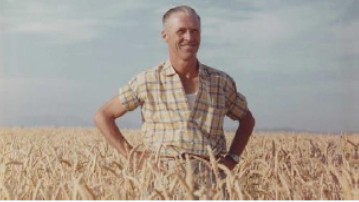
Figure 1. Dr. Norman Borlaug, ca. 1963, Yaqui Valley, Sonora, Mexico.
Borlaug and his team accomplished two basic developments. First, using classical plant breeding methods, they bred dwarf wheat varieties that had a higher harvest index (a higher proportion of the total dry matter yield in the grain versus the vegetative parts of the plant). Second, they developed wheat varieties that were resistant to rust diseases, which had been devastating Mexican wheat crops for several decades. This CIMMYT program began in 1944 when Mexico was importing large amounts of wheat to support the population. Due to the success of this program, Mexico became a net exporter of wheat by 1963.
Borlaug and his colleagues transferred these new wheat varieties to southern Asia and between 1965 to 1970 wheat yields nearly doubled in Pakistan and India, greatly improving food security. These methods have been applied to other crops and other regions with great success (Borlaug, 2002).
In 1996 the first transgenic technologies were introduced in cotton and corn Bt varieties and utilized in crop production systems in the United States as result of molecular breeding programs. This incredible technology involved the insertion of genes from a common soil bacterium, Bacillus thuringiensis. These genes encode the production of insecticidal proteins, and thus, genetically transformed plants produce one or more toxins as they grow. The genes that have been inserted into these varieties produce toxins that are limited in activity almost exclusively to caterpillar pests (Lepidoptera family).
In the leafy green vegetable industry, new lettuce varieties have been developed over the past 40 years that offer the capacity for what is naturally a cool-season plant to be planted in the lower Colorado River Valley in August and September with average daily high temperatures of greater than 100°F. These are truly amazing developments from plant breeding programs.
The improved understanding in cellular-molecular biology and the details of DNA has led to new levels of capacity in crop improvement. This has led to the creation of molecular-markers, which are used in genomic-assisted plant breeding programs to identify genes linked to desired traits.
High-throughput phenotyping has provided the ability for plant geneticists to accurately identify and measure genetic traits. This provides the valuable capability of supplementing genomic information for precision breeding.
It is good to recognize and celebrate positive developments and achievements. Yet it is also important to recognize some major mistakes that have occurred in genetics and plant breeding.
In the early 20th century, a Russian agronomist Trofim Lysenko (Figure 2) was a proponent of Lamarckism, which rejected Mendelian genetics in favor of his own idiosyncratic, pseudoscientific ideas later referred to as Lysenkoism (Cashari and Marshak, 1965).
Lysenko became Director of the Russian Institute of Genetics of the Soviet Academy of Sciences in 1940. He used his political influence and power to suppress dissenting opinions and discredit, marginalize, and imprison his critics, elevating his anti-Mendelian theories to state-sanctioned doctrine, which was supported by Josef Stalin, the General Secretary of the Communist Party and dictator of the Soviet Union. Lysenko not only rejected Mendelian genetics but encouraged farmers to plant very high populations based on his belief in the “law of the life of species”, believing that plants from the same “class” will not compete for resources. That of course was a faulty line of thinking without foundation, and it created disastrous consequences.
Lysenko's ideas and practices in plant breeding and crop production practices contributed to the famines that killed millions of people in the Soviet Union. In addition, the adoption of his methods beginning in 1958 in the People's Republic of China had similarly disastrous results, contributing to the Great Chinese Famine of 1959 to 1961. Stalin favored people like Lysenko who was from a peasant family and was lacking in formal education and academic training and with no affiliations to the academic community. Despite Lysenko’s destructive record, he was promoted and awarded the Medal of Lenin eight times.
As a result of Lysenko’s unorthodox ideas and Stalin’s support of him, Soviet scientists who refused to renounce genetics were dismissed from their posts and left destitute. Many notable Russian scientists were imprisoned.
After tremendous amounts of human suffering due to Lysenko’s influence with the resultant crop failures and the death of Stalin in 1953, Lysenko began to lose favor in the Soviet Union. In 1965 he was finally removed from his position as the Director of the Institute of Genetics at the Academy of Sciences in the Soviet Union after the removal of Nikita Khrushchev as the first secretary of the Communist Party and Premier of the Soviet Union Nikita Khrushchev in 1964. Lysenko was ultimately disgraced in the late 1960s, but he did a lot of damage in 25 years.

Figure 2. Trofim Denesovich Lysenko, 1938.
The continued progress and genetic developments like those we have experienced in the past 60 years are not automatic and have required consistent and committed support in development of our basic understanding of plant genetics and biochemistry and the incorporation of that knowledge into well-directed plant breeding programs. Continued support and development basic science is essential for us to develop new tools with appropriate field applications.
We have many challenges in agriculture, and we need the benefit of good science and its application into our crop production systems to meet the needs of today and the future. We cannot afford a venture and descent into some form of Lysenkoism.
References:
Borlaug,N. E. 2002. "The green revolution revisited and the road ahead".Stockholm, Sweden. Nobelprize.org. https://www.nobelprize.org/uploads/2018/06/borlaug-lecture.pdf
Caspari,E. W.; Marshak, R. E. 1965. "The Rise and Fall of Lysenko". Science.149 (3681): 275–278. Bibcode:1965Sci... 149..275C.doi:10.1126/science.149.3681.275. PMID 17838094
To view this article as a PDF, click here and hit download.
First, I want to thank everyone who participated in last week's Vegetable Pest Losses Survey.
This year's survey included the return of the lettuce disease losses section. While several diseases were present and managed last season, downy mildew accounted for the majority of disease management costs by a wide margin. This really underscores the
impact that last spring's unusually rainy weather had on disease development across the Yuma lettuce production region.
No one can predict exactly what this upcoming spring will bring, but there has been discussion about the possibility of a strong El Niño leading to an extended monsoon season. If that proves true, the conditions would once again support spring
downy mildew development. The pathogen only needs about 3 to 4 hours of continuous leaf wetness to infect lettuce, so periods of overnight moisture, prolonged morning dew, or frequent rainfall when inoculum (spores) are present increase disease risk.
With that in mind, this seems like a good opportunity to review what is known about downy mildew and discuss strategies for its management.
Resistance in lettuce to Bremia lactucae, the causal oomycete pathogen behind downy mildew, is inherited in a gene-for-gene fashion, meaning one major gene product in the plant host interacts with one major gene product in the pathogen. When
resistance is present, this leads to an incompatible interaction between plant and pathogen and results in complete immunity to infection. Resistance genes in these types of interactions most often encode a protein molecule that acts like a burglar
alarm. These molecular sensors in the host bind to proteins secreted specifically by the pathogen, and when that happens a storm of defense responses is activated in the plant that excludes further infection. This is not the only mode of genetic resistance
found in plants, but it is often the most drastic and effective against obligate parasites like downy mildew.
But this simple gene-for-gene interaction often puts incredible selection pressure on the pathogen populations to change such that they can get around the resistance. By losing the molecule that the plant detects in order to initiate a defense response,
the pathogen becomes unrecognizable to the resistance genes a plant variety may have. Just like spraying the same mode of action over and over again leads to a pest population developing resistance to a pesticide, the same selection applies to genetic
resistance. The longer a resistance gene is deployed in a region, the more likely the pathogen population is to change in response until that resistance gene is no longer effective at managing the disease.
One of the biggest challenges with lettuce downy mildew is that B. lactucae is constantly changing over time. It exists as many different races, where each race has a different reaction to the resistance genes bred into lettuce varieties. You
can think of these races as different versions of the same pathogen. A lettuce variety that resists one race may still be susceptible to another.
These races are identified by testing them against a panel of lettuce varieties with known resistance genes. In the western United States, races are named by the International Bremia Evaluation Board-U.S. (IBEB-US) and are given names with a number followed by the country’s abbreviation, such as 8US, 9US, or 10US. The populations found in the western U.S. are different from those found in Europe, so each region uses its own independent naming system.
The downy mildew population has changed considerably over time. Earlier races (1US through 4US) are now rarely found in commercial lettuce production. During the 2000s and 2010s, races 5US through 8US became the most common. Race 9US was recognized after being detected repeatedly between 2015 and 2017, and the newest officially recognized race, 10US, was designated in 2025. Below is a pie chart showing the relative frequency of the races identified from 114 Yuma County downy mildew samples between 2023-2024:

Figure 1: Pathotyping results of 114 lettuce samples from Yuma County collected between 2023 and 2024. Data source: https://bremia.ucdavis.edu/bremia_database_main.php
The results show that much of the downy mildew population found in Yuma County is made up of novel strains of Bremia lactucae that have not yet been officially classified as a race. An official race is only recognized after it has been shown to be stable and widespread over multiple locations and growing seasons. These newer strains may disappear over time, or they may eventually become established and earn an official race designation. In the meantime, this means growers and lettuce breeders in Yuma County are often dealing with strains that can dodge the resistance in some lettuce varieties before those strains are common enough to be officially recognized. It also highlights why relying on resistance alone is not enough to manage the disease.
Table 1: Pathotyping and fungicide sensitivity results of samples from Yuma County collected in 2025.

This trend appears to be continuing. All of the downy mildew samples sent for race testing last season were identified as novel strains rather than known, officially designated races.
It's impossible to predict exactly how these new strains will respond to the resistance genes found in today's commercial lettuce varieties. However, because they have not been previously characterized, they are more likely to overcome existing genetic
resistance than the races we already know about.
New strains develop naturally over time. They can arise when different strains exchange genetics (i.e. intermate) or through random mutations. When growers plant varieties with similar resistance packages over large areas, the pathogen population
is placed under strong selection pressure. Any strain that happens to acquire the ability to infect those resistant varieties gains a major advantage and gets to reproduce without competition where other strains cannot. Over just a few disease
cycles, those successful strains can become much more common in the population until they are the predominant strain overall.
An important point to remember is that the resistance bred into commercial lettuce varieties is not wearing out or becoming weaker over time. The genetics in the lettuce remain just as effective as when the variety was released. What changes is the
pathogen. As the downy mildew population evolves new strains emerge that can bypass resistance genes that previously worked very well.
That means that varieties carrying resistance to races 5US through 10US are still doing exactly what they were designed to do. They continue to suppress those known races and help prevent them from becoming widespread in commercial fields. So, if
you experience significant downy mildew in a field planted with a variety that has a strong resistance package, the culprit is most likely one of these newer, uncharacterized strains rather than a failure of the variety itself.
Unfortunately, Bremia lactucae can evolve much faster than scientists can identify new races and breeders can develop and release resistant varieties. That's why no resistance package should be viewed as a stand-alone solution.
This is also why extension, researchers, and the seed and crop protection industries place so much emphasis on the integrated pest management (IPM) concept. Genetic resistance is an essential tool, but it works best and remains the most sustainable when combined with other management practices. For novel strains that can slip past host resistance, timely fungicide applications and other disease management strategies become especially important for maintaining control.

Figure 2: Mean disease severity by treatment. Disease severity was determined by rating 10 plants within each of the five replicate plots per treatment using the following rating system: 0 = no downy mildew present; 1 = downy mildew present on bottom leaves of plant; 2 = downy mildew present on bottom leaves and lower wrapper leaves; 3 = downy mildew present on bottom leaves and all wrapper leaves; 4 = downy mildew present on bottom leaves, wrapper leaves, and cap leaf; 5 = downy mildew present on entire plant. Disease severity is displayed as the mean of five replicates across all three lettuce varieties and bars show a 95% confidence interval around the mean calculated from individual treatment data. Compact letter display (CLD) above boxes show significantly different treatments (Kruskal-Wallis ANOVA and Dunn’s test). Boxes sharing the same letter(s) are not significantly different from one another. Fb = “followed by” in the rotation. Not all products are registered yet for use in lettuce. The inclusion of specific fungicide products or formulations in these trials does not constitute an endorsement or recommendation over other labeled products.
The most effective way to manage lettuce downy mildew is to use an integrated approach. Plant varieties with a strong resistance package against races 5US through 10US, and pair that resistance with timely, full-label-rate fungicide applications when environmental conditions favor disease. This combination provides the broadest and most reliable protection against both known races and the novel strains that continue to emerge in Yuma County.
If you have any concerns regarding the health of your plants/crops please consider submitting samples to the Yuma Plant Health Clinic for diagnostic service or booking a field visit with me:
Christopher Detranaltes, Ph.D.
Cooperative Extension – Yuma County
Email: cdetranaltes@arizona.edu
Cell: 602-689-7328
6425 W 8th St Yuma, Arizona 85364 – Room 109The Desert Difference: A Showcase of Ag Tech Opportunities for Growing in the Desert begins TODAY Wednesday, November 13th with a Field Demo Day at the Yuma Agricultural Center. The educational workshop will feature 13 of the latest automated and robotic technologies for pest control and improved vegetable production being demonstrated in the field. Registration begins at 7:00 am and the program starts at 7:30 am (agenda below).
The Field Demo Day is part of at wo-day event. The second day will be a standard conference with keynote speakers, breakout sessions and trade booths. The event will be held Thursday, November 14th at the Yuma Civic Center. Details of the event and Conference Day (Day 2) activities can be found here.
Looking forward to seeing everyone at both events!
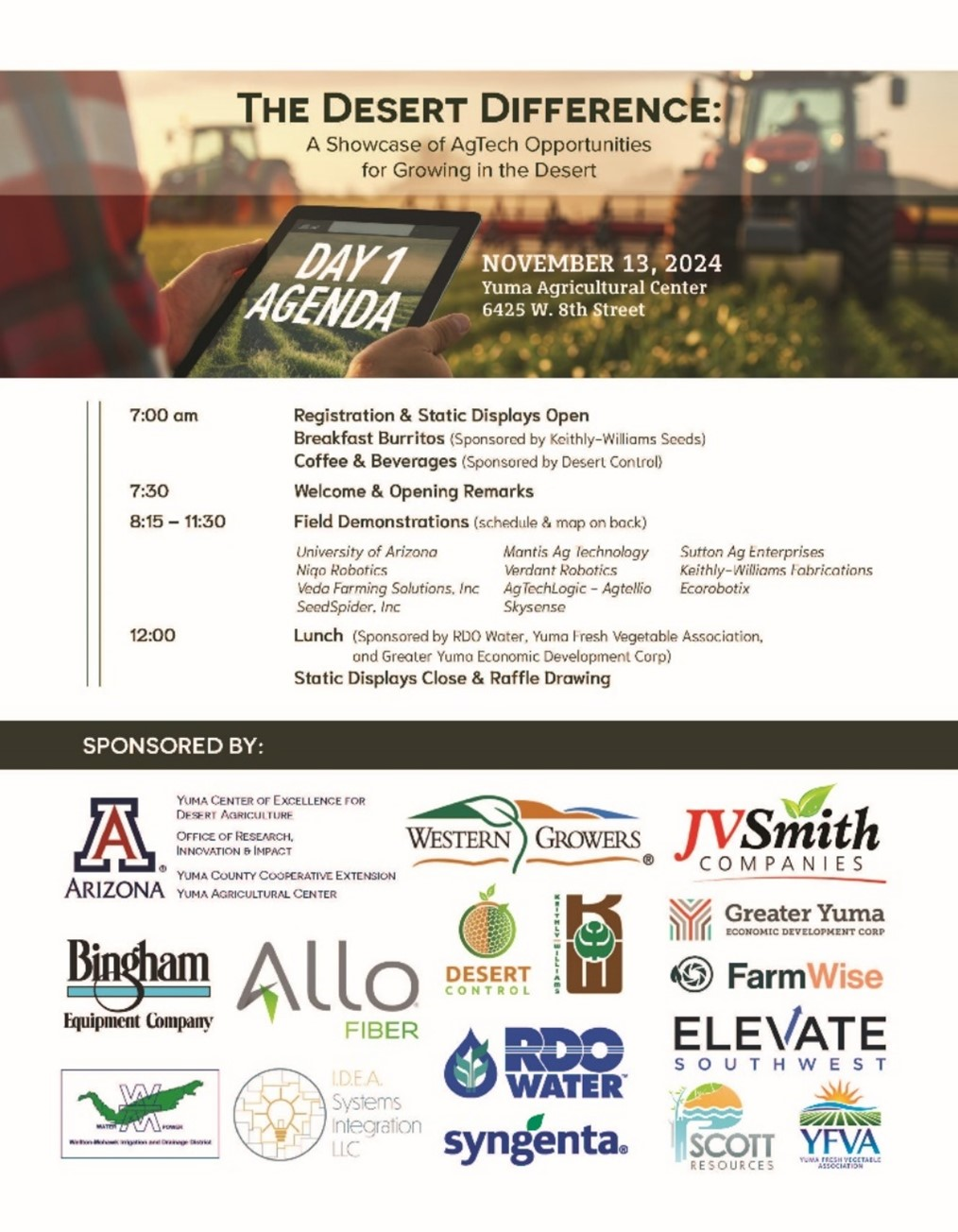
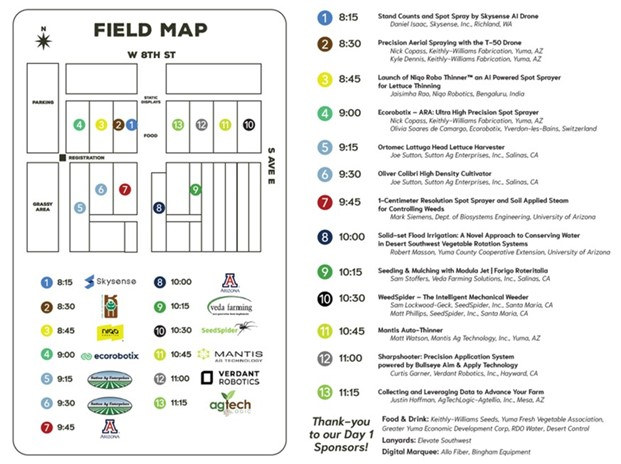
Fig. 1. Field Demo Day agenda (Day 1) for The Desert Difference: A Showcase of Ag
Tech Opportunities for Growing in the Desert event. More information about the event
and Conference Day activities (Day 2) can be found here.
Hi, I’m Chris, and I’m thrilled to be stepping into the role of extension associate for plant pathology through The University of Arizona Cooperative Extension in Yuma County. I recently earned my Ph.D. in plant pathology from Purdue University in Indiana where my research focused on soybean seedling disease caused by Fusarium and Pythium. There, I discovered and characterized some of the first genetic resources available for improving innate host resistance and genetic control to two major pathogens causing this disease in soybean across the Midwest.
I was originally born and raised in Phoenix, so coming back to Arizona and getting the chance to apply my education while helping the community I was shaped by is a dream come true. I have a passion for plant disease research, especially when it comes to exploring how plant-pathogen interactions and genetics can be used to develop practical, empirically based disease control strategies. Let’s face it, fungicide resistance continues to emerge, yesterday’s resistant varieties grow more vulnerable every season, and the battle against plant pathogens in our fields is ongoing. But I firmly believe that when the enemy evolves, so can we.
To that end I am proud to be establishing my research program in Yuma where I will remain dedicated to improving the agricultural community’s disease management options and tackling crop health challenges. I am based out of the Yuma Agricultural Center and will continue to run the plant health diagnostic clinic located there.
Please drop off or send disease samples for diagnosis to:
Yuma Plant Health Clinic
6425 W 8th Street
Yuma, AZ 85364
If you are shipping samples, please remember to include the USDA APHIS permit for moving plant samples.
You can contact me at:
Email: cdetranaltes@arizona.edu
Cell: 602-689-7328
Office: 928-782-5879
Thank you all very much. I look forward to meeting you all soon.
Biological control is a crucial tool for managing pests in organic crop production. Arthropod natural enemies provide significant ecosystem services that favor the suppression of agricultural insect pest populations. When you maintain permanent habitats and food sources for the natural enemies of pests in the vicinity of your farms, it favors the continuous availability of the natural enemies. When the growing season starts, the good bugs will be readily available to attack the pests before they become established in the crops. Planting a diversity of flowering plants (e.g., sweet alyssum, nasturtium, milkweeds, common cryptantha, hillside vervain, wild petunia, etc.) on a small portion of your farms or the farms border can provide adequate food and shelter allowing to maintain abundant and diverse natural enemy species, including syrphid flies, tachinid flies, lacewings, parasitic wasp, etc. that will attack aphids, thrips, lepidopterans, and more.

Figure 1. Insectary plants planted in field margins to attract and conserve natural enemies.

Figure 2. Some suggested insectary plants.
Intercropping, the practice of growing different crops in the same field, is also a suitable agricultural practice for managing insect pests because landscape diversity plays a crucial role in biodiversity conservation and sustainable pest management. Crops grown in intercropping systems are more likely to be less injured than those grown in monoculture. The non-host companion plants can have repellent or deterrent properties that act against insect pests that attack the main crop. Companion plants can also trap the pests, reduce their ability to locate the host plant, and increase the abundance of natural enemies. Like in a push-pull intercropping system, your main crop is intercropped with plant species that can make it less visible or can emit undesirable volatiles (smells) that divert the pests away from the main crop, on the other hand, other plants in your intercropping system can be extremely attractive using stimuli that are highly apparent and attractive to the pest, hence trapping the pest (Fig. 3). Insects use visual, chemical, or tactile cues to locate their host. Thus, by intercropping the main crop with plants that emit more attractive scents, which are more visually appealing, or can release undesirable odors to the pests, we can reduce the abundance and impact of the pest on the main crop.

Figure 3. Pictorial representation of push-pull strategy.
In Brazil, the push-pull strategy has been found effective in managing major kale pests. They found that using mustard as a preferred host pulled the pests away from the kale crops, while marigold plants increased the beneficial arthropod population, which provided additional control of the pests. In Salinas, California, intercropping lettuce with sweet alyssum has favored some measurable aphid control. Sweet alyssum attracts and feeds hoverflies, which then lay eggs in lettuce, producing hoverfly larvae that consume aphids (Fig. 4).

Figure 4. Graphical representation of Lettuce-Alyssum intercropping system for aphids
control. (Image source: Brannan 2013).
As you plan for the next season, you can consider planting flowering plants along the borders of your farms or in dedicated patches to conserve natural enemies and enhance your biological control. When feasible, consider intercropping multiple crop species that are not affected by the same pests; this will reduce the abundance of insect pests and also increase the abundance and diversity of beneficial insects.
Why Water Productivity Matters
Water is one of the most valuable inputs in desert agriculture. Here in Yuma, Arizona, most of our lettuce is irrigated using water from the Colorado River, and every drop counts. One way to measure this efficiency is through Crop Water Productivity (CWP), often called “more crop per drop.”
What is Crop Water Productivity?
CWP tells us how much crop yield we get for each unit of water used.
CWP = Crop Yield/Crop Water Use
A higher CWP means more yield per unit of water an important goal in our desert environment.
Why It’s Important in Yuma
Yuma’s hot, dry, and often windy conditions cause high water loss from soil and plants. Improving CWP helps ensure that every acre-foot of water supports strong, profitable production. Measuring CWP helps identify where we can save water through irrigation timing, soil management, or better agronomic practices.
Physical vs. Economic CWP
CWP can be viewed in two ways:
Physical CWP: How much lettuce (by weight) is produced per unit of water.
Economic CWP: The market value produced per unit of water. What Affects Crop Water Productivity Several factors influence how efficiently crops use water:
Why Compare Organic and Conventional Systems?
Interest in organic lettuce production is growing in the Yuma Valley, but questions remain about its efficiency under desert conditions. Organic systems build soil health with compost and cover crops, which can improve water-holding capacity. However, conventional systems often achieve higher yields due to faster growth and more readily available nutrients. Comparing both systems helps us understand which approach makes better use of limited water resources in Yuma’s unique climate.
Field Study in Yuma Ag Center, 2024–2025
During the 2024–2025 season, a trial was conducted at the Yuma Agricultural Center to measure and compare CWP between organic and conventional iceberg lettuce systems. Both systems were grown under similar conditions using subsurface drip irrigation. This information was used to calculate and compare CWP for each system.
Crop Water Productivity Results
The results from the trial are shown in Figure 1 below. CWP values are expressed as kilograms of lettuce produced per cubic meter of water used (kg/m³). Overall, conventional lettuce produced about 40–50% more yield per unit of water compared to organic systems. This difference was mainly due to stronger plant growth and faster canopy development under conventional fertilization and management. However, organic systems still provide long-term benefits. Healthier soils in organic plots can store more moisture, reduce runoff, and support sustainable water use over time.

Figure 1. Crop Water Productivity (CWP) for organic and conventional iceberg
lettuce systems at the Yuma Ag Center, 2024–2025 season.
Take Home Messages
VegIPM Update Vol. 17, Num. 15
July 22, 2026
Results of trap catches below!!
Whitefly: Adult activity remains steady across locations; above average for this time of the year, especially high numbers seen in North Gila Valley. Historically, whitefly numbers peak in July.
Thrips: Adult thrips activity remained low over the last two weeks. About average for this time of the year. Historically, thrips numbers remain low until Sept-Oct.