Chile (Capsicum annuum) is an important crop in the desert Southwest. The Capsicum annuum species is the most common group of chiles that we encounter and these chiles are common in our southwestern diet. The New Mexico type chile (aka, Anaheim) is the most common type of chile crop in the desert Southwest including production ares in southeastern Arizona, southern New Mexico, west Texas, and northern Chihuahua, Mexico.
There are five domesticated species of chile peppers. 1) Capsicum annuum is probably the most common to us and it includes many common varieties such as bell peppers, wax, cayenne, jalapeños, Thai peppers, chiltepin, and all forms of New Mexico chile. 2) Capsicum frutescens includes malagueta, tabasco, piri piri, and Malawian Kambuzi. 3) Capsicum chinense includes what many consider the hottest peppers such as the naga, habanero, Datil, and Scotch bonnet. 4) Capsicum pubescens includes the South American rocoto peppers. 5) Capsicum baccatum includes the South American aji peppers (Guzman and Bosland, 2017). Some examples are shown in Figure 1 and some other chile pepper species as well.

Figure 1. Capsicum annuum pod types include A) Asian, B) Cayenne, C) Chile de Arbol,
D) Chiltepin, E) Hungarian Paprika, F) Jalapeño, G) New Mexican, and H) Poblano. A
Capsicum baccatum pod type is I) Aji. Capsicum chinense pod types are J) Bhut Jolokia,
K) Habanero, and L) Scorpion. A Capsicum pubescens pod type is M) Rocoto and a
Capsicum frutescens pod type is N) Tabasco. Source: Guzman and Bosland, 2017.
Crop Phenology
Understanding of the basic stages of plant growth in relation to time or age (crop phenology) and basic crop needs, i.e., water and nutrients, is an important part of crop management. There is a strong relationship among the phenological, morphological and physiological changes that occur with crop development. Understanding what is going on physiologically within a plant at various stages of growth and development is critical in efficiently managing crop inputs such as water and plant nutrients.
Plants respond to environmental conditions and temperature is the primary developmental force in plant development when water is not limiting. Heat units (HUs) can be used as a good measure of “thermal time” that drives plant development. Thus, HUs can be used as a management tool for predicting and identifying stages of growth and physiological needs. We can then use that information for more efficient timing of irrigation and nutrient inputs to crop and pest management strategies. Figures 2 and 3 describe the basic HU concept with upper and lower thresholds.
Crop phenology models describe how crop growth and development are impacted by weather and climate and provide an effective way to standardize crop growth and development among different years and across many locations (Baskerville and Emin, 1969; Brown, 1989).
People still use days after planting to estimate stages of crop development but HUs are more accurate and reliable. As a result, HU based methods of predicting and tracking crop growth can be more consistently and effectively used in crop production systems.
The use of HU-based phenology models is most applicable in irrigated crop production systems where water is a non-limiting factor. Water stress will alter phenological plant development and it is a major source of variation irrespective of temperature conditions.
Chiles are a warm season, perennial plant with an indeterminant growth habit that we grow and manage as an annual crop. The fruiting cycle begins at the crown stage of growth (Figures 4 and 5) and continues until the plant reaches a point of “cut-out” with a hiatus in blooming as the plant works to mature the chile fruit that the crop has set and established.
Figure 6 describes the basic phenological baseline for New Mexico – type chile and was developed from field studies conducted in New Mexico and Arizona (Silvertooth et al., 2010 and 2011; Soto et al., 2006; and Soto and Silvertooth, 2007).
Heat units accumulated after planting (HUAP) for any date of planting to the present date can be easily accessed in the Arizona Meteorological Network (AZMET) website.
In the 2025 season, New Mexico-type chiles in southeastern Arizona experienced a good start to the season after planting. In tracking a set of New Mexico-type chile varieties, their development is tracking very closely to the HU model shown in Figure 6. For example, crown formation and first flowers have been consistently observed at approximately 1,300 – 1,450 HUAP among numerous New Mexico type varieties in southeastern Arizona this season. Many fields are progressing through peak bloom consistent with Figure 6 and early set fruit is maturing nicely as well.

Figure 2. Typical relationship between the rate of plant growth and development and
temperature. Growth and development cease when temperatures decline below the
lower temperature threshold (A) or increase above the upper temperature threshold (C).
Growth and development increases rapidly when temperatures fall between the lower
and upper temperature thresholds (B).

Figure 3. Heat unit calculation with the sine curve method using upper and lower
temperature thresholds (Brown, 1989). The 86/55 ºF thresholds are used, consistent
with most warm season crops.
Figure 4. Photo of a New Mexico chile plant with crown formation and the first fruiting
branch shown withing the red circle.
Figure 5. Photo of a New Mexico chile plant with crown formation and early first fruiting
branch development. Source: Courtesy of Mr. Ed Curry, Pearce, AZ.

Figure 6. Basic phenological guideline for irrigated New Mexico-type chiles.
References
Baskerville, G.L. and P. Emin. 1969. Rapid estimation of heat accumulation from maximum and minimum temperatures. Ecology 50:514-517.
Bosland, P.W., E.J. Votava, and E.M. Votava. 2012. Peppers: Vegetable and spice capsicums. Wallingford, U.K.: CAB Intl.
Brown, P. W. 1989. Heat units. Bull. 8915, Univ. of Arizona Cooperative Extension, College of Ag., Tucson, AZ.
Guzmán, I. and P.W. Bosland. 2017. Sensory properties of chile pepper heat - and its importance to food quality and cultural preference. Appetite, 2017 Oct1;117:186-190. doi: 10.1016/j.appet.2017.06.026.
Silvertooth, J.C., P.W. Brown, and S. Walker. 2010. Crop Growth and Development for Irrigated Chile (Capsicum annuum). University of Arizona Cooperative Extension Bulletin No. AZ 1529
Silvertooth, J.C., P.W. Brown and S. Walker. 2011. Crop Growth and Development for Irrigated Chile (Capsicum annuum). New Mexico Chile Association, Report 32. New Mexico State University, College of Agriculture, Consumer and Environmental Science.
Soto-Ortiz, Roberto, J.C. Silvertooth, and A. Galadima. 2006. Crop Phenology for Irrigated Chiles (Capsicumannuum L.) in Arizona and New Mexico. Vegetable Report, College of Agriculture and Life Sciences Report Series P-144, November, University of Arizona.
Soto-Ortiz, R. and J.C. Silvertooth. 2007. A Crop Phenology Model for Irrigated New Mexico Chile (Capsicum annuum L.) The 2007Vegetable Report. Jan 08:104-122.
First, I want to thank everyone who participated in last week's Vegetable Pest Losses Survey.
This year's survey included the return of the lettuce disease losses section. While several diseases were present and managed last season, downy mildew accounted for the majority of disease management costs by a wide margin. This really underscores the
impact that last spring's unusually rainy weather had on disease development across the Yuma lettuce production region.
No one can predict exactly what this upcoming spring will bring, but there has been discussion about the possibility of a strong El Niño leading to an extended monsoon season. If that proves true, the conditions would once again support spring
downy mildew development. The pathogen only needs about 3 to 4 hours of continuous leaf wetness to infect lettuce, so periods of overnight moisture, prolonged morning dew, or frequent rainfall when inoculum (spores) are present increase disease risk.
With that in mind, this seems like a good opportunity to review what is known about downy mildew and discuss strategies for its management.
Resistance in lettuce to Bremia lactucae, the causal oomycete pathogen behind downy mildew, is inherited in a gene-for-gene fashion, meaning one major gene product in the plant host interacts with one major gene product in the pathogen. When
resistance is present, this leads to an incompatible interaction between plant and pathogen and results in complete immunity to infection. Resistance genes in these types of interactions most often encode a protein molecule that acts like a burglar
alarm. These molecular sensors in the host bind to proteins secreted specifically by the pathogen, and when that happens a storm of defense responses is activated in the plant that excludes further infection. This is not the only mode of genetic resistance
found in plants, but it is often the most drastic and effective against obligate parasites like downy mildew.
But this simple gene-for-gene interaction often puts incredible selection pressure on the pathogen populations to change such that they can get around the resistance. By losing the molecule that the plant detects in order to initiate a defense response,
the pathogen becomes unrecognizable to the resistance genes a plant variety may have. Just like spraying the same mode of action over and over again leads to a pest population developing resistance to a pesticide, the same selection applies to genetic
resistance. The longer a resistance gene is deployed in a region, the more likely the pathogen population is to change in response until that resistance gene is no longer effective at managing the disease.
One of the biggest challenges with lettuce downy mildew is that B. lactucae is constantly changing over time. It exists as many different races, where each race has a different reaction to the resistance genes bred into lettuce varieties. You
can think of these races as different versions of the same pathogen. A lettuce variety that resists one race may still be susceptible to another.
These races are identified by testing them against a panel of lettuce varieties with known resistance genes. In the western United States, races are named by the International Bremia Evaluation Board-U.S. (IBEB-US) and are given names with a number followed by the country’s abbreviation, such as 8US, 9US, or 10US. The populations found in the western U.S. are different from those found in Europe, so each region uses its own independent naming system.
The downy mildew population has changed considerably over time. Earlier races (1US through 4US) are now rarely found in commercial lettuce production. During the 2000s and 2010s, races 5US through 8US became the most common. Race 9US was recognized after being detected repeatedly between 2015 and 2017, and the newest officially recognized race, 10US, was designated in 2025. Below is a pie chart showing the relative frequency of the races identified from 114 Yuma County downy mildew samples between 2023-2024:

Figure 1: Pathotyping results of 114 lettuce samples from Yuma County collected between 2023 and 2024. Data source: https://bremia.ucdavis.edu/bremia_database_main.php
The results show that much of the downy mildew population found in Yuma County is made up of novel strains of Bremia lactucae that have not yet been officially classified as a race. An official race is only recognized after it has been shown to be stable and widespread over multiple locations and growing seasons. These newer strains may disappear over time, or they may eventually become established and earn an official race designation. In the meantime, this means growers and lettuce breeders in Yuma County are often dealing with strains that can dodge the resistance in some lettuce varieties before those strains are common enough to be officially recognized. It also highlights why relying on resistance alone is not enough to manage the disease.
Table 1: Pathotyping and fungicide sensitivity results of samples from Yuma County collected in 2025.

This trend appears to be continuing. All of the downy mildew samples sent for race testing last season were identified as novel strains rather than known, officially designated races.
It's impossible to predict exactly how these new strains will respond to the resistance genes found in today's commercial lettuce varieties. However, because they have not been previously characterized, they are more likely to overcome existing genetic
resistance than the races we already know about.
New strains develop naturally over time. They can arise when different strains exchange genetics (i.e. intermate) or through random mutations. When growers plant varieties with similar resistance packages over large areas, the pathogen population
is placed under strong selection pressure. Any strain that happens to acquire the ability to infect those resistant varieties gains a major advantage and gets to reproduce without competition where other strains cannot. Over just a few disease
cycles, those successful strains can become much more common in the population until they are the predominant strain overall.
An important point to remember is that the resistance bred into commercial lettuce varieties is not wearing out or becoming weaker over time. The genetics in the lettuce remain just as effective as when the variety was released. What changes is the
pathogen. As the downy mildew population evolves new strains emerge that can bypass resistance genes that previously worked very well.
That means that varieties carrying resistance to races 5US through 10US are still doing exactly what they were designed to do. They continue to suppress those known races and help prevent them from becoming widespread in commercial fields. So, if
you experience significant downy mildew in a field planted with a variety that has a strong resistance package, the culprit is most likely one of these newer, uncharacterized strains rather than a failure of the variety itself.
Unfortunately, Bremia lactucae can evolve much faster than scientists can identify new races and breeders can develop and release resistant varieties. That's why no resistance package should be viewed as a stand-alone solution.
This is also why extension, researchers, and the seed and crop protection industries place so much emphasis on the integrated pest management (IPM) concept. Genetic resistance is an essential tool, but it works best and remains the most sustainable when combined with other management practices. For novel strains that can slip past host resistance, timely fungicide applications and other disease management strategies become especially important for maintaining control.

Figure 2: Mean disease severity by treatment. Disease severity was determined by rating 10 plants within each of the five replicate plots per treatment using the following rating system: 0 = no downy mildew present; 1 = downy mildew present on bottom leaves of plant; 2 = downy mildew present on bottom leaves and lower wrapper leaves; 3 = downy mildew present on bottom leaves and all wrapper leaves; 4 = downy mildew present on bottom leaves, wrapper leaves, and cap leaf; 5 = downy mildew present on entire plant. Disease severity is displayed as the mean of five replicates across all three lettuce varieties and bars show a 95% confidence interval around the mean calculated from individual treatment data. Compact letter display (CLD) above boxes show significantly different treatments (Kruskal-Wallis ANOVA and Dunn’s test). Boxes sharing the same letter(s) are not significantly different from one another. Fb = “followed by” in the rotation. Not all products are registered yet for use in lettuce. The inclusion of specific fungicide products or formulations in these trials does not constitute an endorsement or recommendation over other labeled products.
The most effective way to manage lettuce downy mildew is to use an integrated approach. Plant varieties with a strong resistance package against races 5US through 10US, and pair that resistance with timely, full-label-rate fungicide applications when environmental conditions favor disease. This combination provides the broadest and most reliable protection against both known races and the novel strains that continue to emerge in Yuma County.
If you have any concerns regarding the health of your plants/crops please consider submitting samples to the Yuma Plant Health Clinic for diagnostic service or booking a field visit with me:
Christopher Detranaltes, Ph.D.
Cooperative Extension – Yuma County
Email: cdetranaltes@arizona.edu
Cell: 602-689-7328
6425 W 8th St Yuma, Arizona 85364 – Room 109Interested in more information about mechanical weed control in vegetable crops? Check out this seminar given by Sam Hitchcock Tilton, Lakeshore Technical College. Topics covered include weed ecology, systems-based strategies for weed control, new and emerging machines on the market, individual tools and implements and best-use strategies for cultivating equipment. Although the target audience is small-scale vegetable growers, Sam gives many practical tips and insights that are applicable to large-scale vegetable farms. Even if you’re very knowledgeable about mechanical cultivation, this entertaining seminar is a good refresher on the basics of integrated weed management and one I think you’ll find interesting and informative.
Fig. 1. Sam Hitchcock Tilton presenting seminar entitled “Mechanical Weed
Control and Weed Ecology in Vegetable Production”. Click the video above to view a recording of the presentation. (Photo credits: Practical Farmers of Iowa,
Ames, IA).
In our last update we invited you to come to the YAC to look at a broccoli trial we have in which we sprayed Trifluralin at 1.5 pt/ acre preemergence (PREE) incorporated mechanically. The application was made to the flat ground then incorporated with a disk at 4”depth. Then rows were built, and broccoli was direct seeded and germinated with sprinkler irrigation. Last year we saw injury in a non-disked Treflan treatment, so I didn’t include it in the trial. The same procedure was done with Prowl at 1pt with disked and non-disked plots.
Additional PREE treatments were Devrinol at 1pt/a, Prefar6qt/a, Goal tender at high rate of 16floz/a.
Prowl mechanically incorporated looks better than Non-incorporated in weed control as well as not showing phytotoxicity symptoms. Treflan, also mechanically incorporated looks similar to Prowl with a very small number of large weeds. The predominant weeds in this field are goosefoot and lambs quarter and are showing restricted growth not being as competitive with the broccoli.
Our observations in the trial as well as your field experience shows us with Treflan and Prowl available PREE and the post emergence herbicides such as Clethodim and Goal the absence of Cacthal can be mitigated to some degree. Again, you are welcome to come look at it at the Yuma Ag Center.
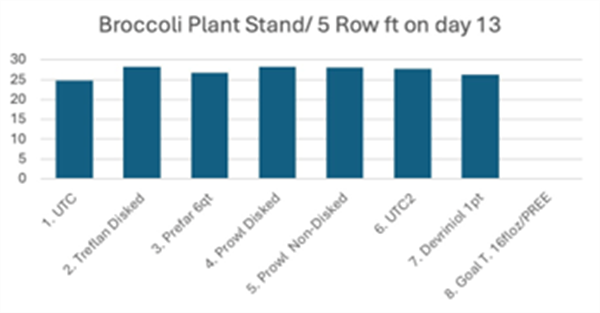
Treatments didn’t affect broccoli stand except Goal high rate PREE as expected.
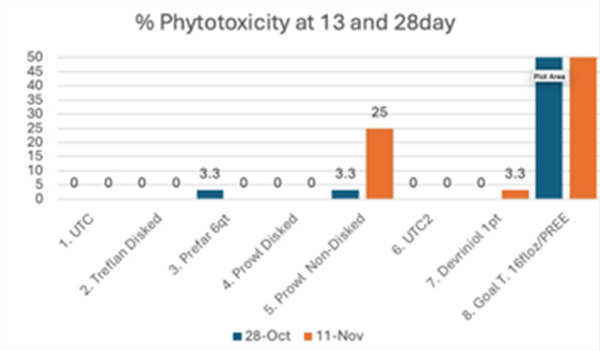
Prowl and Treflan applied on the flat and incorporated mechanically did not produced phytotoxicity symptoms at 13 and 28 days after planting.
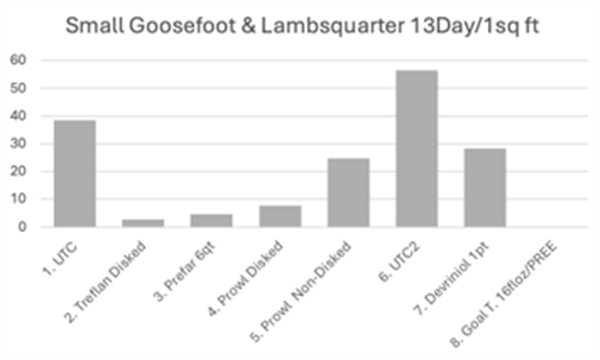
All weeds were about 0.5” at the time of this evaluation.
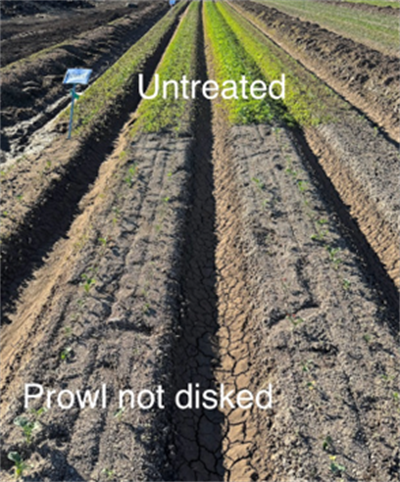
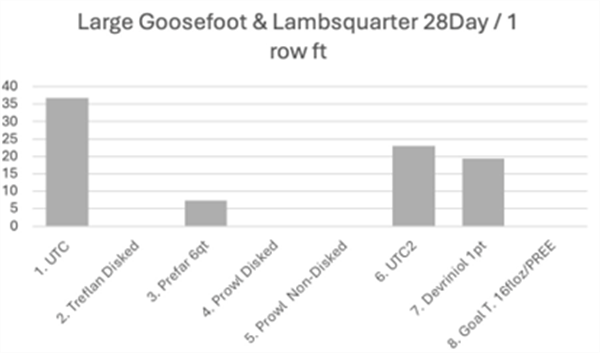
Some of the small weeds observed in the 13-day evaluation in the disked Prowl and Treflan died or didn’t grow by day 28.
Diamondback moth (DBM) has become a major challenge for Arizona brassica growers, with increasing reports of insecticide resistance and difficult fall and spring seasons.
To address this challenge, University of Arizona Extension entomologists and the Arizona Department of Agriculture, led by Dr. Wilfrid Calvin, collaborated to create new, practical guidelines for managing DBM in both transplant production and field settings.
The document offers practical, Arizona-focused strategies that can help prevent DBM and improve control.
The document can be found here: Guidelines for Effective Management of Diamondback Moth in Brassica CropsAs lettuce season approaches, irrigation management becomes critical for maintaining optimal soil moisture levels in the active root zone. Proper irrigation not only supports healthy crop growth but also prevents excessive water applications that can lead to nitrate leaching, an issue of both environmental concern and economic loss. Likewise, under-irrigation can reduce nitrogen uptake, as adequate soil moisture is essential for root absorption. This is especially critical in an extremely dry region like Yuma, where maintaining optimal soil moisture directly impacts both water and nitrogen use efficiency. This article provides an in-depth guide for growers on how to schedule irrigation based on crop growth stage, system type, and current weather conditions. The article introduces updated crop coefficient (Kc) values developed specifically for Yuma lettuce production through recent field research led by Drs. Sanchez and French, in partnership with Yuma Center of Excellence for Desert Agriculture (YCEDA). It also explains how to use the Arizona Meteorological Network(AZMET) and other practical evapotranspiration tools to make irrigation decisions more precise and site-specific.
Combining updated Kc values, local reference ET data, and irrigation efficiency concepts, this resource empowers growers to improve water use efficiency and sustain high yields and enhance different cropping systems in the region.
Click this link to read the full article: Estimating Crop Evapotranspiration Using Lettuce Crop Coefficients for Irrigation Scheduling in Yuma, Arizona.
VegIPM Update Vol. 17, Num. 15
July 22, 2026
Results of trap catches below!!
Whitefly: Adult activity remains steady across locations; above average for this time of the year, especially high numbers seen in North Gila Valley. Historically, whitefly numbers peak in July.
Thrips: Adult thrips activity remained low over the last two weeks. About average for this time of the year. Historically, thrips numbers remain low until Sept-Oct.