In the last two issues of this UA Vegetable IPM Newsletter, I have presented a melon (Cucumis melo ‘reticulatus’ L.) crop phenology model (Figure 1; Silvertooth, 2025a) based on actual heat unit accumulations (86/55 ºF thresholds). This model can be useful in predicting and tracking crop development and identifying important stages of crop growth and development (crop phenology).
Referring to the data from AZMET for several locations in the Yuma area, the HU accumulations from 1 January 2025 for a set of four possible 2025 planting dates are listed in Table 1. The HU accumulations from 1 January 2025 to 28 April 2025 for these sites are listed in Table 2.
The HU accumulations after planting (HUAP) for these four possible planting dates for three Yuma area locations to 28 April 2025 are shown in Table 3. The HUAP values in Table 3 are simply the difference between the values in Tables 1 and 2.
An example for the Yuma Valley, 15 January 2025 planting date is: HU from 1 January to 28 April 1096 - 73 HU accumulated at planting on 15 January = 1023 HUAP for this case.
The information in Table 3 can help serve as a reference to check for melon crop
development in the field against this phenological model in Figure 1. In the most edition of this newsletter (Silvertooth, 2025b) the projected stages of growth were presented based on this phenological model and current HU accumulations.
Based on this phenology model and current HU accumulations for this season we should be able to make some projections on the current stage of growth, which we can go to the field and check. For example, for melon fields in the lower Colorado River Valley at this time, we can expect to find fields planted and watered up in mid-January to have crown set melons maturing and approaching harvest conditions. These fields could have crown fruit ready for harvesting in about three weeks, based on these projections and normal HU accumulation patterns for this time of year. For fields planted and wet dates near the first of March, these fields should have small crown set melons approaching golf ball size.

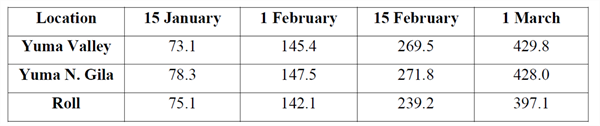
Table 1. Heat unit accumulations (86/55 ºF thresholds) after 1 January 2025 on four
possible 2025 planting dates utilizing Arizona Meteorological Network (AZMET) data for
each representative site.
Yuma Valley: https://azmet.arizona.edu/application-areas/heat-units/station-level-summaries/az02
Yuma North Gila: https://azmet.arizona.edu/application-areas/heat-units/station-level-summaries/az14
Roll: https://azmet.arizona.edu/application-areas/heat-units/station-level-summaries/az24

Table 2. Heat unit accumulations (86/55 ºF thresholds) after 1 January 2025 to 14
April 2025 utilizing Arizona Meteorological Network (AZMET) data for each
representative site.

Table 3. Heat unit accumulations (86/55 ºF thresholds) after planting (HUAP) from four
possible 2025 planting dates and three sites in the Yuma area on 30 April 2025 utilizing
Arizona Meteorological Network (AZMET) data for each representative site. Each value
is rounded to the next whole number. Note: the values in Table 3 are determined by
taking the difference between the HUs for each representative site and four planting
dates in Tables 1 and 2.
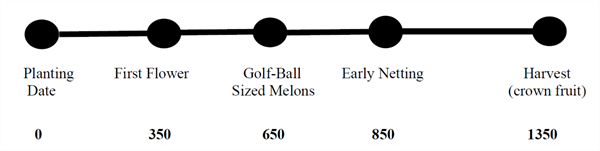
Figure 1. Melon (cantaloupe) phenological development model expressed in Heat Units
Accumulated After Planting (HUAP, 86/55 oF).
First, I want to thank everyone who participated in last week's Vegetable Pest Losses Survey.
This year's survey included the return of the lettuce disease losses section. While several diseases were present and managed last season, downy mildew accounted for the majority of disease management costs by a wide margin. This really underscores the
impact that last spring's unusually rainy weather had on disease development across the Yuma lettuce production region.
No one can predict exactly what this upcoming spring will bring, but there has been discussion about the possibility of a strong El Niño leading to an extended monsoon season. If that proves true, the conditions would once again support spring
downy mildew development. The pathogen only needs about 3 to 4 hours of continuous leaf wetness to infect lettuce, so periods of overnight moisture, prolonged morning dew, or frequent rainfall when inoculum (spores) are present increase disease risk.
With that in mind, this seems like a good opportunity to review what is known about downy mildew and discuss strategies for its management.
Resistance in lettuce to Bremia lactucae, the causal oomycete pathogen behind downy mildew, is inherited in a gene-for-gene fashion, meaning one major gene product in the plant host interacts with one major gene product in the pathogen. When
resistance is present, this leads to an incompatible interaction between plant and pathogen and results in complete immunity to infection. Resistance genes in these types of interactions most often encode a protein molecule that acts like a burglar
alarm. These molecular sensors in the host bind to proteins secreted specifically by the pathogen, and when that happens a storm of defense responses is activated in the plant that excludes further infection. This is not the only mode of genetic resistance
found in plants, but it is often the most drastic and effective against obligate parasites like downy mildew.
But this simple gene-for-gene interaction often puts incredible selection pressure on the pathogen populations to change such that they can get around the resistance. By losing the molecule that the plant detects in order to initiate a defense response,
the pathogen becomes unrecognizable to the resistance genes a plant variety may have. Just like spraying the same mode of action over and over again leads to a pest population developing resistance to a pesticide, the same selection applies to genetic
resistance. The longer a resistance gene is deployed in a region, the more likely the pathogen population is to change in response until that resistance gene is no longer effective at managing the disease.
One of the biggest challenges with lettuce downy mildew is that B. lactucae is constantly changing over time. It exists as many different races, where each race has a different reaction to the resistance genes bred into lettuce varieties. You
can think of these races as different versions of the same pathogen. A lettuce variety that resists one race may still be susceptible to another.
These races are identified by testing them against a panel of lettuce varieties with known resistance genes. In the western United States, races are named by the International Bremia Evaluation Board-U.S. (IBEB-US) and are given names with a number followed by the country’s abbreviation, such as 8US, 9US, or 10US. The populations found in the western U.S. are different from those found in Europe, so each region uses its own independent naming system.
The downy mildew population has changed considerably over time. Earlier races (1US through 4US) are now rarely found in commercial lettuce production. During the 2000s and 2010s, races 5US through 8US became the most common. Race 9US was recognized after being detected repeatedly between 2015 and 2017, and the newest officially recognized race, 10US, was designated in 2025. Below is a pie chart showing the relative frequency of the races identified from 114 Yuma County downy mildew samples between 2023-2024:

Figure 1: Pathotyping results of 114 lettuce samples from Yuma County collected between 2023 and 2024. Data source: https://bremia.ucdavis.edu/bremia_database_main.php
The results show that much of the downy mildew population found in Yuma County is made up of novel strains of Bremia lactucae that have not yet been officially classified as a race. An official race is only recognized after it has been shown to be stable and widespread over multiple locations and growing seasons. These newer strains may disappear over time, or they may eventually become established and earn an official race designation. In the meantime, this means growers and lettuce breeders in Yuma County are often dealing with strains that can dodge the resistance in some lettuce varieties before those strains are common enough to be officially recognized. It also highlights why relying on resistance alone is not enough to manage the disease.
Table 1: Pathotyping and fungicide sensitivity results of samples from Yuma County collected in 2025.

This trend appears to be continuing. All of the downy mildew samples sent for race testing last season were identified as novel strains rather than known, officially designated races.
It's impossible to predict exactly how these new strains will respond to the resistance genes found in today's commercial lettuce varieties. However, because they have not been previously characterized, they are more likely to overcome existing genetic
resistance than the races we already know about.
New strains develop naturally over time. They can arise when different strains exchange genetics (i.e. intermate) or through random mutations. When growers plant varieties with similar resistance packages over large areas, the pathogen population
is placed under strong selection pressure. Any strain that happens to acquire the ability to infect those resistant varieties gains a major advantage and gets to reproduce without competition where other strains cannot. Over just a few disease
cycles, those successful strains can become much more common in the population until they are the predominant strain overall.
An important point to remember is that the resistance bred into commercial lettuce varieties is not wearing out or becoming weaker over time. The genetics in the lettuce remain just as effective as when the variety was released. What changes is the
pathogen. As the downy mildew population evolves new strains emerge that can bypass resistance genes that previously worked very well.
That means that varieties carrying resistance to races 5US through 10US are still doing exactly what they were designed to do. They continue to suppress those known races and help prevent them from becoming widespread in commercial fields. So, if
you experience significant downy mildew in a field planted with a variety that has a strong resistance package, the culprit is most likely one of these newer, uncharacterized strains rather than a failure of the variety itself.
Unfortunately, Bremia lactucae can evolve much faster than scientists can identify new races and breeders can develop and release resistant varieties. That's why no resistance package should be viewed as a stand-alone solution.
This is also why extension, researchers, and the seed and crop protection industries place so much emphasis on the integrated pest management (IPM) concept. Genetic resistance is an essential tool, but it works best and remains the most sustainable when combined with other management practices. For novel strains that can slip past host resistance, timely fungicide applications and other disease management strategies become especially important for maintaining control.

Figure 2: Mean disease severity by treatment. Disease severity was determined by rating 10 plants within each of the five replicate plots per treatment using the following rating system: 0 = no downy mildew present; 1 = downy mildew present on bottom leaves of plant; 2 = downy mildew present on bottom leaves and lower wrapper leaves; 3 = downy mildew present on bottom leaves and all wrapper leaves; 4 = downy mildew present on bottom leaves, wrapper leaves, and cap leaf; 5 = downy mildew present on entire plant. Disease severity is displayed as the mean of five replicates across all three lettuce varieties and bars show a 95% confidence interval around the mean calculated from individual treatment data. Compact letter display (CLD) above boxes show significantly different treatments (Kruskal-Wallis ANOVA and Dunn’s test). Boxes sharing the same letter(s) are not significantly different from one another. Fb = “followed by” in the rotation. Not all products are registered yet for use in lettuce. The inclusion of specific fungicide products or formulations in these trials does not constitute an endorsement or recommendation over other labeled products.
The most effective way to manage lettuce downy mildew is to use an integrated approach. Plant varieties with a strong resistance package against races 5US through 10US, and pair that resistance with timely, full-label-rate fungicide applications when environmental conditions favor disease. This combination provides the broadest and most reliable protection against both known races and the novel strains that continue to emerge in Yuma County.
If you have any concerns regarding the health of your plants/crops please consider submitting samples to the Yuma Plant Health Clinic for diagnostic service or booking a field visit with me:
Christopher Detranaltes, Ph.D.
Cooperative Extension – Yuma County
Email: cdetranaltes@arizona.edu
Cell: 602-689-7328
6425 W 8th St Yuma, Arizona 85364 – Room 109Given the positive feedback from last week’s article, I thought I’d share with you another video that showcases the cutting-edge advancements in AI technologies. This time, the topic is Digital AI Twins. Reid Hoffman, a renowned expert in AI technologies, has created a digital twin of himself named “Reid AI” using a custom Generative Pretrained Transformer (GPT). Reid AI was trained using content from over two decades worth of Hoffman’s public speeches, podcasts and published books. The result is a digital entity that mirrors Hoffman’s knowledge, insights, and even his conversational style. In the segment, Hoffman interviews his AI counterpart. The conversation is not only entertaining but also very realistic, blurring the lines between human and machine. I was pretty impressed and think you will be too. Given the rapid advancements in these technologies, one can’t help but wonder what’s next in the evolution of AI and how this technology will change the world.
Check it out here or by clicking image below.
Fig. 1. Reid Hoffman meets his AI twin. (Credit: Reid Hoffman).
As the weather gets cooler, aphids are migrating back to the desert to harm our crops. It is important to revisit some factors that may favor aphid infestations in your crops, specifically lettuce, and take appropriate action against them.
Nitrogen availability is one of the most important factors in the development of insect pest populations. Excessive application of nitrogen fertilizer to crops will likely increase the feeding preference and consumption rate of insect pests such as aphids, resulting in greater survival, growth, and reproduction. In some situations, high nitrogen levels in plant tissue can decrease resistance and increase susceptibility to aphids’ attacks.
Water management is also very important to consider. Excess water around plant roots can increase nitrogen uptake, which may favor an increase in the aphid population. Thus, supplying proper amounts of nitrogen and water to your crops can tremendously help with aphid management. See this link for more information on this topic.I had the privilege of knowing Dr. John Palumbo for nearly a year, and in that short time, he left a lasting impact on me both personally and professionally. From the moment I joined the Yuma Agricultural Center, John welcomed me with genuine generosity, readily offering his help and connecting me with key stakeholders in the Yuma area. Despite the demands of his extensive and impactful program, his office door was always open for any questions I had. Just a few weeks ago, I was attending a workshop in Imperial, California, hosted by the University of California Cooperative Extension. During the IPM session, I believe his name was mentioned more than ten times, underscoring the depth and influence of his research, findings, and recommendations. John was a true leader of the agricultural community in the Southwest, and his contributions will continue to shape the field for years to come. He leaves behind a legacy of excellence, mentorship, and service. Thank you, Dr. John Palumbo, for everything you have done. You will be deeply missed and fondly remembered.

VegIPM Update Vol. 17, Num. 15
July 22, 2026
Results of trap catches below!!
Whitefly: Adult activity remains steady across locations; above average for this time of the year, especially high numbers seen in North Gila Valley. Historically, whitefly numbers peak in July.
Thrips: Adult thrips activity remained low over the last two weeks. About average for this time of the year. Historically, thrips numbers remain low until Sept-Oct.