The Colorado River watershed and water distribution system (Figure 1) is one of the largest in the U.S. The main channel of the Colorado River extends over 1,450 miles, covers 244,000 square miles in the drainage basin, and has the greatest elevation fall of any watershed in North America. The Colorado River supports more than 40M people, nearly 6M acres of cropland, 30 native American tribes, and provides large amounts of electrical power generation for the southwestern U.S.

Figure 1. The Colorado River watershed. Source: USGS.
The average annual flow in the Colorado River between 1906-2017 was 14.8 million acre-feet (MAF), Figure 2. The allocated water for diversion on the Colorado River has been 16.5 MAF (15 MAF in the U.S. + 1.5 MAF to Mexico). Thus, there has been a structural deficit of at least 2.0 MAF for many years. Between 2000 and 2018, the average annual flow has been ~ 12.4 MAF, which has further compounded the problem creating an overall deficit of ~ 4.0 MAF.

Figure 2. Colorado River Annual Flow, 1905-2010 with an overall average and
10-year average. Source: Bureau of Reclamation.
The foundation to the governance of the Colorado River is commonly referenced to the “Law of the River”, which is based on the Colorado River Compact of 1922 (CRC of 1922) and a collection of laws, contracts, agreements, definitions, and precedents from previous legal cases. Thus, the Law of the River is not one distinct entity but rather an amalgam of various components. A key foundational component is the CRC of 1922 which was formally negotiated among the basin states to define how much water from the Colorado River can be used by each state on an annual basis. Other agreements contribute to the aggregate Law of the River, including a 1944 Treaty, that agreed to send Colorado River water allocations to Mexico.
The CRC of 1922 was developed following a period of relatively high annual flows. Based on the records associated with the transactions leading to the signing of the CRC of 1922, the hydrologists and other scientists were providing data and interpretations to the commission that significantly influenced the CRC of 1922.
The CRC of 1922 established the operational base of Colorado River water allocation providing 15 MAF allocated among the seven basin states. Even though annual flow in the river has been less than that in most years, river managers have been able to make it work for 100 years. However, due to the annual average flow of the past 20 years being ~ 12.4 MAF, the allocation of Colorado River water based on the original CRC of 1922 has not been sustainable (Figure 2).
The Colorado River Basin is managed in a complex and multi-level legal structure that involves many stakeholders. The Colorado River watershed is divided into the Upper and Lower Basins. The Upper Basin includes the states of Wyoming, Colorado, Utah and New Mexico. The Lower Basin includes Arizona, California and Nevada. A binational treaty governs the releases to Mexico from both the Upper Basin and Lower Basin (1944 Water Treaty and Minute 319).
Due to the impacts of the recent drought, the basin states negotiated interim guidelines to deal with Colorado River water shortages and determined the reductions for each state depending on the elevation of water in Lake Mead in 2007. The reductions associated with a shortage of Colorado River water were further augmented in 2019 by the Drought Contingency Plan (DCP) among the basin states, with specific guidelines for both the upper and lower-basin states.
Within the overall structure of the Law of the River, the basin states and the Boulder Canyon Project Act water contractors must work collectively to address their water supply issues. In the Lower Basin, water supplies are administered by a federal water master, designated as the Secretary of the Interior working through the Bureau of Reclamation. In the Upper Basin, the Upper Colorado River Commission administers compliance with the 1922 Colorado River Compact. In addition, every basin also has its own unique set of laws governing the water rights that apply within those states.
The 2007 Interim Guidelines for Lower Basin Shortages and the Coordinated Operations for both Lake Powell and Lake Mead are set to expire in 2026. The seven Colorado River Basin states and stakeholders must work together to develop the new criteria that will replace those guidelines. At present, there is a gridlock in those negotiations between the Upper and Lower Basin states and it must be resolved in 2025 to replace those guidelines expiring in 2026.
Fall melon season is approaching, and one recurring question I've been hearing is: Will viruses be as bad this fall as they were in the spring?
The incidence and severity of melon viruses this past spring were unprecedented across Yuma County, Imperial County, and northern Mexico. This is supported by the volume of feedback we received from growers, PCAs, and industry representatives who attended the June 2nd melon virus incident response meeting. As a result, predicting what we can expect is going to happen this fall is difficult. We have no recent, if any, experience with virus pressure at this scale in spring melon to guide our expectations for the upcoming fall season. At this point, predictions are more of an educated guess without the guidance of past observations.
To quickly recap, the three main viruses that affected cucurbits this spring were cucurbit yellow stunting disorder virus (CYSDV), cucurbit chlorotic yellows virus (CCYV), and watermelon chlorotic stunt virus (WmCSV). All three are transmitted by the Biotype B whitefly (Bemisia tabaci), whose populations overwintered at unusually high levels between 2025 and 2026. Between melon seasons, these viruses persist in a wide range of crop and weed hosts, many of which show few or no visible symptoms of infection. Unfortunately, these asymptomatic plants can still serve as reservoirs, allowing both the viruses and their whitefly vectors to bridge the melon-free gap between cropping seasons and provide a source of inoculum for newly planted fields. It is an unfortunate reality that neither the whitefly vectors nor many of the alternate host plants (weeds) show symptoms or suffer ill effects while carrying these viruses. As a result, they can stealthily maintain virus populations between melon seasons and serve as a source of infection for newly planted fields.
Below is a compilation of reported host plants for CYSDV, CCYV, and WmCSV. This list reflects the viruses’ confirmed hosts identified to date but is unlikely to be exhaustive. Additional weed and crop species may also be capable of serving as reservoirs for these viruses but have yet to be discovered or reported. Note that many of these plants may grow throughout the region as weeds, native vegetation, commercial crops, or in backyard gardens:
Table 1: Primary and alternate hosts of CYSDV, CCYV, and WmCSV reported to date.

I can see this upcoming melon season unfolding in one of two ways. On one hand, the most intuitive prediction is that the high virus inoculum and abundant whitefly populations present during the spring melon season will carry over into the fall, resulting in early and significant virus pressure. On the other hand, the intensive whitefly management programs implemented throughout the spring may have suppressed vector populations to provide knockdown to pre-winter 2025 levels, resulting in lower virus incidence early in the season than at the start of spring.
Regardless of which scenario plays out, proactive and preventative management of both whiteflies and weed reservoirs remains the most effective strategy for minimizing virus pressure in fall melons. This approach targets two critical stages of the disease cycle by reducing the initial sources of virus inoculum and limiting the whitefly vectors responsible for further virus spread.
Dr. Palumbo developed a management guide for whiteflies and CYSDV in fall melons in 2024. The recommendations are based on research findings from two key publications and provide practical guidance for reducing virus risk throughout the season, from planting through netted fruit (Castle 2017a and 2017b).
Table 2: Insecticide Use Guidelines for Whitefly /CYSDV Management in Fall Melons

The earlier melons become infected with one or more of these viruses, the greater the impact on plant growth, fruit development, and ultimately yield. Even when infection cannot be completely prevented, delaying virus establishment can substantially reduce losses in both yield and fruit quality. Protecting young plants from early whitefly feeding, and virus infection, is therefore one of the most important management objectives to reducing losses.
In field trials comparing at-plant soil applications of flupyradifurone (trade name Sivanto), dinotefuran (Venom), imidacloprid (Admire Pro), and cyantraniliprole (Verimark), Dr. Palumbo and colleagues found that flupyradifurone and dinotefuran provided the greatest protection against both whiteflies and lowest final incidence of CYSDV (Castle et al. 2017b). All products were applied as a single soil shank injection at planting, allowing systemic uptake and protection during crop establishment.
Across both spring and fall trials, flupyradifurone consistently produced the lowest whitefly densities and the lowest incidence of CYSDV. Dinotefuran was the second most effective treatment, significantly reducing both whitefly populations and CYSDV incidence, although its performance was somewhat less consistent than flupyradifurone. In contrast, at-planting treatment with imidacloprid and cyantraniliprole did not consistently reduce CYSDV incidence.
Further reading:
Castle, S., Palumbo, J., Merten, P., Cowden, C. and Prabhaker, N. (2017a), Effects of foliar and systemic insecticides on whitefly transmission and incidence of cucurbit yellow stunting disorder virus. Pest. Manag. Sci., 73: 1462-1472. https://doi.org/10.1002/ps.4478
Castle, S.J., Palumbo, J.P., Merten, P. (2017b), Field evaluation of cucurbit yellow stunting disorder virus transmission by Bemisia tabaci. Virus Res., 241:220-227. doi: https://doi.org/10.1016/j.virusres.2017.03.017
If you have any concerns regarding the health of your plants/crops please consider submitting samples to the Yuma Plant Health Clinic for diagnostic service or booking a field visit with me:
Christopher Detranaltes, Ph.D.
Cooperative Extension – Yuma County
Email: cdetranaltes@arizona.edu
Cell: 602-689-7328
6425 W 8th St Yuma, Arizona 85364 – Room 109
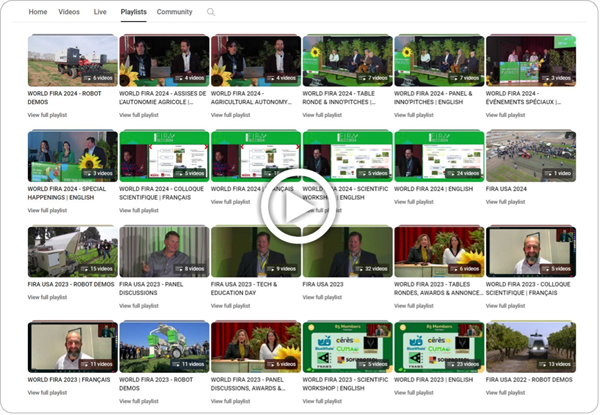
Interested in staying up to date on the latest robotic ag technologies? The International Forum for Agricultural Robotics, FIRA, hosts two annual conferences focusing on robotics and autonomous farming solutions, one in Europe and one in the USA. They recently uploaded recordings of sessions from the 2024 World FIRA, held in Toulouse, France to YouTube. The site also contains playlists of themed breakout sessions from previous European and USA events (over 400 videos total). Highlights include panel discussions with growers and company executives, robot demos, and inno’pitches from startup companies. Most of the content, particularly from the USA events, is high quality and worth viewing.
Check it out by clicking here or on the image below.
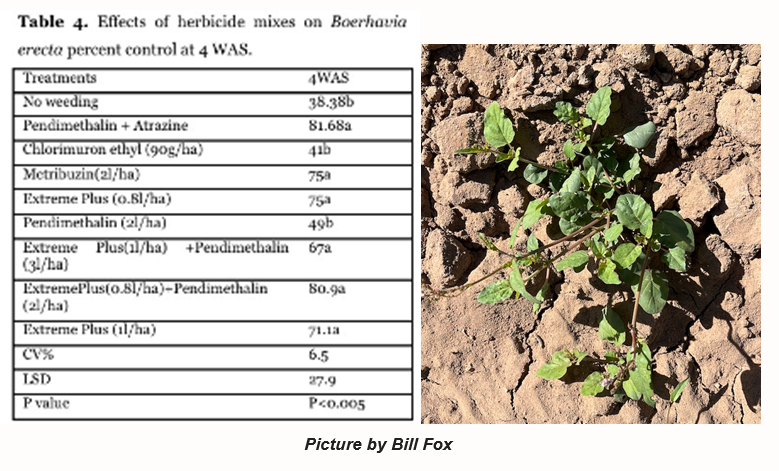
Boerhavia coulteri is a flowering plant that belongs to the Nyctaginaceae or Four O'clock family known by the common name Coulter's spiderling. Its native to the desert areas of the SW in the US and North of Mexico. It is a summer annual or perennial weed producing an erect or creeping stem up to 0.7-0.8 m in length. Grows in disturbed areas, ditch banks, and roadsides.

The cotyledons are oblong,1.0-2.5 cm.
Plants are slightly pubescent with sticky resin glands toward the bases. The leaves are lance-shaped, somewhat triangular, pointed, sometimes wavy or rippled along the edges, and 5 centimeters in maximum length1.
We have this weed in our Yuma County AZ and very abundantly in the sandy soils of the Yuma Mesa.
I added a table from a weed control experiment conduced for Boheravia erecta.
The Research Paper called :” The effect of herbicide tank mix on the weed species diversity
in sugarcane (Saccharum officinarum)” mentions: “All the herbicide mixes significantly controlled Boheravia with Pendimethalin. Being Pendimethalin plus Atrazine the best treatment as shown in the table below.
I am delighted to embark on my first produce season here in Yuma, AZ. I am looking forward to becoming acquainted with the growing region this fall as we begin identifying tools that can enhance our pest management strategies, specifically focusing on organic solutions for managing insect pests in the Desert Southwest. It is also important for me to gain a deeper understanding of the challenges and issues you are facing in the field. We are eager to evaluate both current and new biopesticides in our upcoming trials and look forward to engaging with potential collaborators.
Here is a list of our fall 2024 trials:
1- Evaluation of selected bioinsecticides against Lepidopteran pests in Brassicas
2- Evaluation of selected bioinsecticides against whiteflies in Brassicas
3- Alternative bioinsecticides for thrips management in lettuce
4- Assessing the effectiveness of beneficial insects (T. brassicae, T. pretiosum, and green lacewings) release for diamondback moth control in Brassicas
I hope everyone’s season gets off to a fantastic start. Please contact me or Macey if you have specific pest issues, biopesticides, or other organic IPM practices you would like us to evaluate. Your expertise is truly invaluable to us!
Contact Information:
• Wilfrid Calvin
Assistant Professor & Extension Specialist
Cell: (979) 709-9762
Office: (928) 782-5861
e-mail: wilfridcalvin@arizona.edu
• Macey Keith
Assistant in Extension
Cell: (928) 580-5785
e-mail: maceyw@catmail.arizona.edu
Lake Mead, the nation’s largest reservoir, continues to decline to historic lows, posing a critical hydrological challenge in the Southwest with significant implications for Arizona agriculture. Prolonged and severe drought across the Colorado River Basin has led to cascading water-use reductions, including a Tier 1 shortage that has cut central Arizona’s agricultural water allocations by 65%.
The drought situation in Arizona has intensified significantly since late 2024 (see Figures 1 & 2 to determine the differences in extreme drought expansion), with extreme drought (D3) conditions spreading across much of the state. Yuma, La Paz, Maricopa, Gila, and now Greenlee counties are fully engulfed in D3 drought, while the expansion has also reached parts of Pima, Mohave, Yavapai, Navajo, Apache, Santa Cruz, Graham, and Cochise counties. This alarming trend signals a severe water deficit, raising serious concerns about its impact on agriculture, water resources, ecosystems, and communities statewide. This crisis underscores the urgent need for innovative strategies to sustain agriculture and secure water resources in the region.
One approach to addressing this crisis is implementing conservative water management, which includes adopting advanced soil moisture monitoring technologies. This raises an important question: How do you select the right soil moisture sensors for irrigation management decisions?
A wide range of soil moisture sensors are commercially available for agricultural use. However, selecting the most suitable sensor for Yuma’s arid environment, where soils are characterized by a pH greater than 8 requires careful consideration of key criteria. The selection process should focus on two critical aspects:
(a) Operational Feasibility:
(b) Performance Accuracy:
Calibration: Consideration of factory calibrations versus site-specific calibrations for improved measurement precision.


VegIPM Update Vol. 17, Num. 14
July 8, 2026
Results of trap catches below!!
Whitefly: Adult activity remains steady across locations; above average for this time of the year. Historically, whitefly numbers peak in July.
Thrips: Adult thrips activity decreased over the last two weeks. About average for this time of the year. Historically, thrips numbers remain low until Sept-Oct.
Diamondback Moth: No diamondback moths have been collected in the traps since May 19th. Based on the past six years summer collection data, no DBM is collected in the traps in the summer months (Jun-Aug) until September.