Soil Nitrogen
Nitrogen (N) is the essential nutrient that is required in largest amounts by plants. Following water, N is the most limiting factor in the growth and development of non-leguminous crops.
In most places around the world, sunlight is the first most limiting factor in terrestrial ecosystems, including crop production systems. This is followed closely by water as a limiting factor to plant growth and biologically available N (NO3- -N) is commonly the third most limiting factor.
Nitrogen goes through many natural transformations in the soil and cycling of N can take many routes and forms. Thus, the management of N is also one of the most challenging plant nutrients to work with efficiently.
Even though N is often a limiting factor in terrestrial ecosystems and crop production systems, N is ubiquitous in the atmosphere and biosphere. For example, 78% of the Earth’s atmosphere is made up of N gas or N2, a molecule made of two nitrogen atoms bonded together by a strong, stable, triple bond. As a result, N gas is biologically inert.
Nitrogen is the mineral element required by plants in the greatest amount and it serves many functions in plant physiology. Nitrogen is an integral component of amino acids, which are the building blocks for proteins.
Proteins are present in the plant as enzymes that are responsible for metabolic reactions in the plant. Because N is so important, plants often respond dramatically to plant-available N, which is nitrate-nitrogen (NO3- -N), (Havlin, et al. 2014; Thompson and Troeh, 2005; Warren, et al., 2017; and Weiland Brady, 2017).
Nitrogen is central to global crop production. Many parts of the world do not have enough to achieve food and nutrition security, in other cases excess N from fertilizer leaks into the environment with damaging consequences.
Though it makes up a large portion of the air we breathe, most living organisms cannot access N in this form. Atmospheric N must go through a natural process called “nitrogen fixation” to transform before it can be used for plant nutrition.
In both plants and humans, N is used to make amino acids, which make the proteins that construct cells, including the building blocks for DNA. It is also essential for plant growth because it is a major component of chlorophyll, the compound by which plants use sunlight energy to produce sugars from water and carbon dioxide(photosynthesis).
The Nitrogen Cycle
The N cycle is the multi-faceted process through which N moves from the atmosphere to earth, through soils and organisms, and is released back into the atmosphere, with conversions in and out of organic and inorganic forms (Figure1).

Figure 1. The nitrogen cycle.
A good point to begin the review of the N cycle is with biological N fixation, the process of converting biologically inert N2 gas into an organic compound or an inorganic form such as NO3- -N. Nitrogen fixation can take place through basic routes: 1) biological fixation or 2) conversion of N2 gas to NO3--N by lightning. The basic routes of N fixation are shown in the upper left-hand side of Figure 1.
Biological fixation occurs when naturally occurring N-fixing symbiotic and some non-symbiotic bacteria convert N2 gas from air into forms like ammonium-nitrogen (NH4+ -N) and then into nitrate-nitrogen (NO3- -N). A very important form of biological N fixation is carried out by symbiotic bacteria that live in the root nodules of legumes converting N2 gas into ammonium (NH4+) and then nitrate (NO3-), which are commonly incorporated very quickly into organic forms.
Plants preferentially absorb nitrate -N (NO3- -N) from the soil through the root hairs and use it in their physiological systems to create the N forms they need (amino acids, proteins, enzymes, complex compounds, etc.). Some ammonium-N (NH4+-N) can be taken up by some plants. The preferential form of N for plant uptake and utilization is nitrate-N (NO3--N).
Organic forms of N are not taken up by the plant and incorporated into the plant physiology.
Denitrifying bacteria convert excess nitrate back into inorganic N which can be released back into the atmosphere in gaseous forms (N2O and N2).
Nitrogen fixation can also begin with lightning, the heat from which ruptures the triple bonds of atmospheric nitrogen (N2 gas), freeing its atoms to combine with oxygen and creating nitrous oxide gas (N2O), which dissolves in rain forming nitric acid (HNO3) which then can be absorbed by the soil.
Excess nitrate in the soil can be lost through leaching, the process where nutrients mobile in the soil, including nitrate-N, can pass through the soil profile and into groundwater and potentially polluting streams.
Because N is so important and plant-available forms are often limiting, plants often respond dramatically to available N. There are no substitutes for sufficient plant-available N and management is a critical part of a crop production system.
References
Havlin, J.L., Beaton, J.D., Tisdale, S.L. and Nelson, W.L. 2014. Soil Fertility and Fertilizers; An Introduction to Nutrient Management. 6th Edition, Prentice Hall, Upper Saddle River, NJ.
Troeh, F.R. and Thompson, L.M. (2005) Soils and Soil Fertility. Sixth Edition, Blackwell, Ames, Iowa, 489.
Warren, J., H. Zhang, B. Arnall, J. Bushong, B. Raun, C. Penn, and J. Abit. Oklahoma Soil Fertility Handbook. Published Apr. 2017; Id: E-1039
Weil, R.R. and Brady, N.C. (2017) The Nature and Properties of Soils. 15th Edition, Pearson, New York.
First, I want to thank everyone who participated in last week's Vegetable Pest Losses Survey.
This year's survey included the return of the lettuce disease losses section. While several diseases were present and managed last season, downy mildew accounted for the majority of disease management costs by a wide margin. This really underscores the
impact that last spring's unusually rainy weather had on disease development across the Yuma lettuce production region.
No one can predict exactly what this upcoming spring will bring, but there has been discussion about the possibility of a strong El Niño leading to an extended monsoon season. If that proves true, the conditions would once again support spring
downy mildew development. The pathogen only needs about 3 to 4 hours of continuous leaf wetness to infect lettuce, so periods of overnight moisture, prolonged morning dew, or frequent rainfall when inoculum (spores) are present increase disease risk.
With that in mind, this seems like a good opportunity to review what is known about downy mildew and discuss strategies for its management.
Resistance in lettuce to Bremia lactucae, the causal oomycete pathogen behind downy mildew, is inherited in a gene-for-gene fashion, meaning one major gene product in the plant host interacts with one major gene product in the pathogen. When
resistance is present, this leads to an incompatible interaction between plant and pathogen and results in complete immunity to infection. Resistance genes in these types of interactions most often encode a protein molecule that acts like a burglar
alarm. These molecular sensors in the host bind to proteins secreted specifically by the pathogen, and when that happens a storm of defense responses is activated in the plant that excludes further infection. This is not the only mode of genetic resistance
found in plants, but it is often the most drastic and effective against obligate parasites like downy mildew.
But this simple gene-for-gene interaction often puts incredible selection pressure on the pathogen populations to change such that they can get around the resistance. By losing the molecule that the plant detects in order to initiate a defense response,
the pathogen becomes unrecognizable to the resistance genes a plant variety may have. Just like spraying the same mode of action over and over again leads to a pest population developing resistance to a pesticide, the same selection applies to genetic
resistance. The longer a resistance gene is deployed in a region, the more likely the pathogen population is to change in response until that resistance gene is no longer effective at managing the disease.
One of the biggest challenges with lettuce downy mildew is that B. lactucae is constantly changing over time. It exists as many different races, where each race has a different reaction to the resistance genes bred into lettuce varieties. You
can think of these races as different versions of the same pathogen. A lettuce variety that resists one race may still be susceptible to another.
These races are identified by testing them against a panel of lettuce varieties with known resistance genes. In the western United States, races are named by the International Bremia Evaluation Board-U.S. (IBEB-US) and are given names with a number followed by the country’s abbreviation, such as 8US, 9US, or 10US. The populations found in the western U.S. are different from those found in Europe, so each region uses its own independent naming system.
The downy mildew population has changed considerably over time. Earlier races (1US through 4US) are now rarely found in commercial lettuce production. During the 2000s and 2010s, races 5US through 8US became the most common. Race 9US was recognized after being detected repeatedly between 2015 and 2017, and the newest officially recognized race, 10US, was designated in 2025. Below is a pie chart showing the relative frequency of the races identified from 114 Yuma County downy mildew samples between 2023-2024:

Figure 1: Pathotyping results of 114 lettuce samples from Yuma County collected between 2023 and 2024. Data source: https://bremia.ucdavis.edu/bremia_database_main.php
The results show that much of the downy mildew population found in Yuma County is made up of novel strains of Bremia lactucae that have not yet been officially classified as a race. An official race is only recognized after it has been shown to be stable and widespread over multiple locations and growing seasons. These newer strains may disappear over time, or they may eventually become established and earn an official race designation. In the meantime, this means growers and lettuce breeders in Yuma County are often dealing with strains that can dodge the resistance in some lettuce varieties before those strains are common enough to be officially recognized. It also highlights why relying on resistance alone is not enough to manage the disease.
Table 1: Pathotyping and fungicide sensitivity results of samples from Yuma County collected in 2025.

This trend appears to be continuing. All of the downy mildew samples sent for race testing last season were identified as novel strains rather than known, officially designated races.
It's impossible to predict exactly how these new strains will respond to the resistance genes found in today's commercial lettuce varieties. However, because they have not been previously characterized, they are more likely to overcome existing genetic
resistance than the races we already know about.
New strains develop naturally over time. They can arise when different strains exchange genetics (i.e. intermate) or through random mutations. When growers plant varieties with similar resistance packages over large areas, the pathogen population
is placed under strong selection pressure. Any strain that happens to acquire the ability to infect those resistant varieties gains a major advantage and gets to reproduce without competition where other strains cannot. Over just a few disease
cycles, those successful strains can become much more common in the population until they are the predominant strain overall.
An important point to remember is that the resistance bred into commercial lettuce varieties is not wearing out or becoming weaker over time. The genetics in the lettuce remain just as effective as when the variety was released. What changes is the
pathogen. As the downy mildew population evolves new strains emerge that can bypass resistance genes that previously worked very well.
That means that varieties carrying resistance to races 5US through 10US are still doing exactly what they were designed to do. They continue to suppress those known races and help prevent them from becoming widespread in commercial fields. So, if
you experience significant downy mildew in a field planted with a variety that has a strong resistance package, the culprit is most likely one of these newer, uncharacterized strains rather than a failure of the variety itself.
Unfortunately, Bremia lactucae can evolve much faster than scientists can identify new races and breeders can develop and release resistant varieties. That's why no resistance package should be viewed as a stand-alone solution.
This is also why extension, researchers, and the seed and crop protection industries place so much emphasis on the integrated pest management (IPM) concept. Genetic resistance is an essential tool, but it works best and remains the most sustainable when combined with other management practices. For novel strains that can slip past host resistance, timely fungicide applications and other disease management strategies become especially important for maintaining control.

Figure 2: Mean disease severity by treatment. Disease severity was determined by rating 10 plants within each of the five replicate plots per treatment using the following rating system: 0 = no downy mildew present; 1 = downy mildew present on bottom leaves of plant; 2 = downy mildew present on bottom leaves and lower wrapper leaves; 3 = downy mildew present on bottom leaves and all wrapper leaves; 4 = downy mildew present on bottom leaves, wrapper leaves, and cap leaf; 5 = downy mildew present on entire plant. Disease severity is displayed as the mean of five replicates across all three lettuce varieties and bars show a 95% confidence interval around the mean calculated from individual treatment data. Compact letter display (CLD) above boxes show significantly different treatments (Kruskal-Wallis ANOVA and Dunn’s test). Boxes sharing the same letter(s) are not significantly different from one another. Fb = “followed by” in the rotation. Not all products are registered yet for use in lettuce. The inclusion of specific fungicide products or formulations in these trials does not constitute an endorsement or recommendation over other labeled products.
The most effective way to manage lettuce downy mildew is to use an integrated approach. Plant varieties with a strong resistance package against races 5US through 10US, and pair that resistance with timely, full-label-rate fungicide applications when environmental conditions favor disease. This combination provides the broadest and most reliable protection against both known races and the novel strains that continue to emerge in Yuma County.
If you have any concerns regarding the health of your plants/crops please consider submitting samples to the Yuma Plant Health Clinic for diagnostic service or booking a field visit with me:
Christopher Detranaltes, Ph.D.
Cooperative Extension – Yuma County
Email: cdetranaltes@arizona.edu
Cell: 602-689-7328
6425 W 8th St Yuma, Arizona 85364 – Room 109In the preceding issue of UA Veg IPM Updates, the article below was published with an incorrect link to the video mentioned. For those interested in the video, which contains trial results and insightful videos of the technologies in action, the article has been updated with the correct link and is being reposted.
A couple years ago, we conducted evaluations of various “new” technologies for cultivating weeds in cotton as compared to conventional methods. The new technologies included 1) a camera-guided side-shift hitch and 2) finger weeders, an in-row weeding tool (Fig. 1). Camera-guidance of the maneuverable hitch allows cultivating tools to be positioned close to the seed row. In the study, the uncultivated band was 3.5" for the camera-guided system, and 6” for the conventional cultivator. The aim of evaluating these technologies was to determine their efficacy in controlling herbicide resistant weeds. Trials conducted over 3 years showed that use of camera-guidance improved weed control by more than 30% and finger weeders removed about 45% of the in-row weeds. Overall weed control using the two technologies together was roughly > 90% for broadleaf weeds and about 85% for all weeds species.
Studies conducted by Texas A&M over two years showed similar results (Dotray et. al, 2021).
It is logical to think that similar type results would be realized in vegetable crops such as broccoli and cauliflower, plants that also have fairly long plant stems at the seedling stage of growth. A better than 40% reduction of in-row weeds would significantly lower hand weeding requirements. If you are interested in trying these technologies in vegetable or other crops on your farm, please contact me. We still have the equipment and I’d be happy to work with you.
A presentation given on the trial results and videos of the equipment used operating can be found by clicking here or on image below.
References
Dotray, P.A., Keeling, J.W., & Russell, K.R. 2021. Precision cultivation with finger weeder systems. Project No. 20-190 Final Report. Cary, N.C: Cotton Inc.
Acknowledgements
Project partially funded and supported by Arizona Cotton Growers Association, Cotton Inc., KULT-Kress, LLC and Keithly-Williams Fabrication. We thank them for their support.
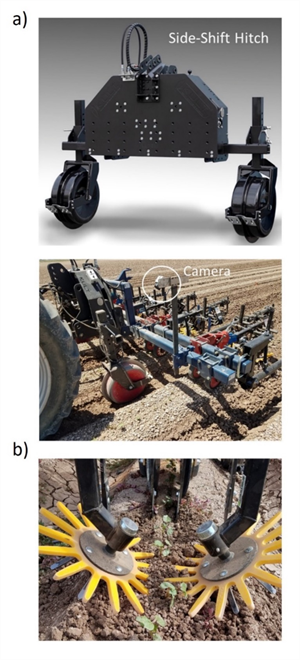
Fig. 1. Technologies for precision cultivation and in-row weeding
used in efficacy trials included a a) a camera-guided side-shift hitch
attached to a cultivator and b) in-row weeding tools (finger weeders).
Fig. 2. Click on image above to watch presentation on precision cultivation and in-row weeding technologies.
The Southwest Agricultural Summit that recently took place in Yuma included a breakout session on Thursday, 21 February 2024 titled “New Developments in Weed Control”.
In this session Jose Antonio Cabrera representing BASF technical services for Coastal CA and Arizona provided a review of the new technologies being developed by his company in the Weed Control area. This includes new active ingredients as well as novel encapsulation technologies. The breakout session also included the lecture “Registration Support for Pest Management Tools in Specialty Crops, The IR-4 Project: Purpose and Process” by Roger B. Batts. “The IR-4 Project was established in 1963 by the U.S. Department of Agriculture to ensure that specialty crop farmers have legal access to safe and effective crop protection products. Helps growers address pest management concerns, develops data necessary for the registration of safe and effective pest management solutions with the U.S. Environmental Protection Agency1.
Roger is the Weed Science biologist from the NC State University IR-4 headquarters. If you have questions such as: What is the IR-4 Mission? Why is IR-4 Needed? What are the programs within the IR-4 project? you will find some answers in the IR-4 Presentation Slides here.
We are currently conducting trials in Yuma in coordination with this project that could result in the addition of new labels and weed control tools for our Arizona vegetable growers.
Thank you for attending the SW Ag Summit Weed Science breakout session.
Reference:
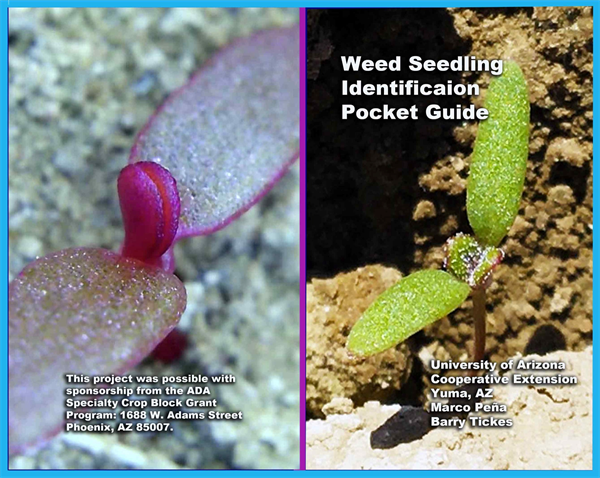
Get your free copy of the Weed Seedling Identification Pocket Guide at the Yuma
Agricultural Center.
Integrated pest management (IPM) involves the utilization of a combination of several tactics for the effective management of pests. This concept was developed by entomologists and is currently adopted by pest managers to target many kinds of pests, including insects, weeds, and pathogens. Most IMP tactics fit well in both conventional and organic crop production. It is not uncommon that most pest management techniques that are approved for organic crop production are not very effective as a stand-alone tactic. Therefore, it is essential to use a combination of pest management techniques that will complement each other to control the pests adequately. This is like a many little hammers approach, where each of the management tactics is a little hammer hammering on the pests. When planning your IPM programs targeting pests in organic crop production, it is important to consider planting resistant/tolerant varieties, scouting regularly, implementing economic thresholds (when possible), practicing cultural control, physical/mechanical control, and biological control, and applying biopesticides when necessary.
• Resistant varieties: Resistant varieties are crucial for effective IPM in organic crop production. When available, the use of resistant varieties should be the first line of defense against pests. Resistant varieties help save on production costs and mitigate environmental impacts associated with insecticides and their applications.
• Cultural control: Cultural control includes cropping systems (trap cropping and push-pull), planting date (early planting or late planting), crop rotation, and growing of crop varieties with early maturity traits. Implementing trap cropping and/or push-pull systems can cause the diversion of insect pests. Early or late planting, crop rotation, and variety with early maturity traits can favor the avoidance of damaging insect pest pressures.
• Scouting: Proper and timely scouting helps determine the levels of pest infestations, allowing the pest manager to trigger control action in a timely fashion. Scouting also helps to prevent unnecessary insecticide applications.
• Economic thresholds: The economic threshold determines the pest or injury level at which control action should be taken. The economic threshold works side by side with scouting. This helps to determine when a management action should be triggered, allowing a reduction of unnecessary insecticide utilization, which will consequently help in delaying or mitigating resistance.
• Physical/mechanical control: This method includes establishing physical barriers, plowing, and sanitation (elimination of volunteer crops and other potential hosts). Plowing can help to bury soil insect pests deep into the ground, directly kill them, and expose soil insects to adverse weather conditions, birds, and other predators, which will adversely impact these pest populations.
• Biological control: This method involves using insect pests’ natural enemies, including predators such as spiders, lady beetles, syrphid fly larvae, big-eyed bugs, pirate bugs, lacewing larvae, and parasitoids such as parasitic wasps and flies.
• Biopesticides: Biopesticides are based on botanical extracts, entomopathogenic fungi, entomopathogenic bacteria, or entomopathogenic viruses that have adverse effects on insect pests. Entrust, Bt, Pyganic, AZA-Neem, M-Pede, Celite, and Venerate are commonly used insecticides for insect pest control in organic crops grown in Arizona.
The implementation of IPM permits to manage pests economically while preserving the environment and reducing negative impacts on human health. In other words, IPM aims at managing pests in an economically viable, socially acceptable, and environmentally safe manner. It is important to note that all the IPM tactics are not always viable in all situations (IPM is not a one-size-fits-all). Therefore, the management techniques choice for an IPM program should be done on a case-by-case basis.
VegIPM Update Vol. 17, Num. 15
July 22, 2026
Results of trap catches below!!
Whitefly: Adult activity remains steady across locations; above average for this time of the year, especially high numbers seen in North Gila Valley. Historically, whitefly numbers peak in July.
Thrips: Adult thrips activity remained low over the last two weeks. About average for this time of the year. Historically, thrips numbers remain low until Sept-Oct.