Justus von Liebig was a 19th century German scientist (1803-1873) who is regarded as one of founders of organic chemistry. He is also commonly considered as the “father of agricultural chemistry and the fertilizer industry.”
Liebig developed several important analytical methods used in a broad range of applications as well as many other important contributions and developments. Liebig was one of the great chemistry teachers of the 19th century that served as a foundation for the robust German chemical industry of the 20thand 21st centuries.
In 1840 Justus von Liebig presented a concept that is known as the “Law of the Minimum”, which was built upon a theory that had first been developed by Carl Sprengel, a German botanist (1787-1859). The Law of the Minimum basically states that a plant’s rate and extent of growth and overall health is dependent on the amount of the scarcest of the essential nutrients that are available to the plant (Figure 1; Liebig, 1840 and van der Ploeg et al., 1999).
The Law of the Minimum has been further applied into a general model of all organisms and biological functions, including the limiting effects of other environmental factors i.e., sunlight and water in terrestrial ecosystems, as well as excesses of nutrients and other environmental factors (Bruuselma and Nigon, 2023; Davidson, 2016; and Mosaic, 2023).
An important way to consider the Law of the Minimum is that the growth of plants, or crops, is not dependent on the total amount of nutrients available, but rather by the scarcest nutrient or resource (i.e., water). This is particularly important in relation to nutrients such as nitrogen, which is the nutrient required in largest amounts by plants, and it is the most common limiting plant nutrient. In desert agriculture, water is commonly the first most common limiting factor in plant growth and development, closely followed by bio-available nitrogen.
The Law of the Minimum is important to understand in managing fertilizer and other agronomic inputs to a crop. This has been demonstrated when fertilizer prices are high, particularly for nitrogen and phosphate fertilizers, and growers may be inclined to reduce or eliminate fertilizer applications.
Liebig’s Law of the Minimum is most applicable for nutrients and plant growth factors that are mobile in the soil. This is particularly relevant for nitrogen, which is available to plants in the nitrate form (NO3--N), which is mobile in the soil. Thus, (NO3--N) moves with soil-water.
Accordingly, the Liebig Law of the Minimum also pertains to water in a soil-plant system. Other growth factors or nutrients will not compensate for a deficiency in a given nutrient or plant growth factor. Plant-available nitrate-nitrogen (NO3--N) or water are good examples, there are no substitutes.
The Liebig Law of the Minimum is an important concept in soil fertility and plant nutrition and overall agronomic crop management in an irrigated production system.

Figure 1. Graphic illustration of the Law of the Minimum with shortest stave in
the barrel representing the most limiting nutrient in the soil-plant system.
References:
Bruulsema, T, and Nigon, L.L. Crops & Soils Magazine, November–December 2023 American Society of Agronomy. pp. 54-59.
Davidson, D. 2016. Nutrient Management Magazine.https://www.no-tillfarmer.com/articles/5648-no-till-notes-how-to-plan-your-summer-fertility-program?v=preview
Liebig, J. 1840. Die organische Chemie in ihrer Anwendung auf Agri- Sprengel, C. 1831. Chemie fu¨ r Landwirthe, Forstma¨nner und Cameralisten (Chemistry for agronomists, foresters, and agricultural econo-cultur und Physiologie (Organic chemistry in its applications to agri-culture and physiology). Friedrich Vieweg und Sohn Publ. Co., mists). Volume 1. Vandenhoeck und Ruprecht Publ. Co., Go¨ ttingen, Germany. Braunschweig, Germany.
Mosaic. 2023. How Law of the Minimum Impacts Crops' Nutrient Use. In: No-Till Farmer. https://www.notillfarmer.com/articles/12637-how-law-of-the-minimum-impacts-crops-nutrient-use
Vander Ploeg, A.R; Böhm, W.; and M. B. Kirkham. 1999. On the Origin of the Theory of Mineral Nutrition of Plants and the Law of the Minimum. Soil Sci. Soc. Am. J. 63:1055–1062.
Fall melon season is approaching, and one recurring question I've been hearing is: Will viruses be as bad this fall as they were in the spring?
The incidence and severity of melon viruses this past spring were unprecedented across Yuma County, Imperial County, and northern Mexico. This is supported by the volume of feedback we received from growers, PCAs, and industry representatives who attended the June 2nd melon virus incident response meeting. As a result, predicting what we can expect is going to happen this fall is difficult. We have no recent, if any, experience with virus pressure at this scale in spring melon to guide our expectations for the upcoming fall season. At this point, predictions are more of an educated guess without the guidance of past observations.
To quickly recap, the three main viruses that affected cucurbits this spring were cucurbit yellow stunting disorder virus (CYSDV), cucurbit chlorotic yellows virus (CCYV), and watermelon chlorotic stunt virus (WmCSV). All three are transmitted by the Biotype B whitefly (Bemisia tabaci), whose populations overwintered at unusually high levels between 2025 and 2026. Between melon seasons, these viruses persist in a wide range of crop and weed hosts, many of which show few or no visible symptoms of infection. Unfortunately, these asymptomatic plants can still serve as reservoirs, allowing both the viruses and their whitefly vectors to bridge the melon-free gap between cropping seasons and provide a source of inoculum for newly planted fields. It is an unfortunate reality that neither the whitefly vectors nor many of the alternate host plants (weeds) show symptoms or suffer ill effects while carrying these viruses. As a result, they can stealthily maintain virus populations between melon seasons and serve as a source of infection for newly planted fields.
Below is a compilation of reported host plants for CYSDV, CCYV, and WmCSV. This list reflects the viruses’ confirmed hosts identified to date but is unlikely to be exhaustive. Additional weed and crop species may also be capable of serving as reservoirs for these viruses but have yet to be discovered or reported. Note that many of these plants may grow throughout the region as weeds, native vegetation, commercial crops, or in backyard gardens:
Table 1: Primary and alternate hosts of CYSDV, CCYV, and WmCSV reported to date.

I can see this upcoming melon season unfolding in one of two ways. On one hand, the most intuitive prediction is that the high virus inoculum and abundant whitefly populations present during the spring melon season will carry over into the fall, resulting in early and significant virus pressure. On the other hand, the intensive whitefly management programs implemented throughout the spring may have suppressed vector populations to provide knockdown to pre-winter 2025 levels, resulting in lower virus incidence early in the season than at the start of spring.
Regardless of which scenario plays out, proactive and preventative management of both whiteflies and weed reservoirs remains the most effective strategy for minimizing virus pressure in fall melons. This approach targets two critical stages of the disease cycle by reducing the initial sources of virus inoculum and limiting the whitefly vectors responsible for further virus spread.
Dr. Palumbo developed a management guide for whiteflies and CYSDV in fall melons in 2024. The recommendations are based on research findings from two key publications and provide practical guidance for reducing virus risk throughout the season, from planting through netted fruit (Castle 2017a and 2017b).
Table 2: Insecticide Use Guidelines for Whitefly /CYSDV Management in Fall Melons

The earlier melons become infected with one or more of these viruses, the greater the impact on plant growth, fruit development, and ultimately yield. Even when infection cannot be completely prevented, delaying virus establishment can substantially reduce losses in both yield and fruit quality. Protecting young plants from early whitefly feeding, and virus infection, is therefore one of the most important management objectives to reducing losses.
In field trials comparing at-plant soil applications of flupyradifurone (trade name Sivanto), dinotefuran (Venom), imidacloprid (Admire Pro), and cyantraniliprole (Verimark), Dr. Palumbo and colleagues found that flupyradifurone and dinotefuran provided the greatest protection against both whiteflies and lowest final incidence of CYSDV (Castle et al. 2017b). All products were applied as a single soil shank injection at planting, allowing systemic uptake and protection during crop establishment.
Across both spring and fall trials, flupyradifurone consistently produced the lowest whitefly densities and the lowest incidence of CYSDV. Dinotefuran was the second most effective treatment, significantly reducing both whitefly populations and CYSDV incidence, although its performance was somewhat less consistent than flupyradifurone. In contrast, at-planting treatment with imidacloprid and cyantraniliprole did not consistently reduce CYSDV incidence.
Further reading:
Castle, S., Palumbo, J., Merten, P., Cowden, C. and Prabhaker, N. (2017a), Effects of foliar and systemic insecticides on whitefly transmission and incidence of cucurbit yellow stunting disorder virus. Pest. Manag. Sci., 73: 1462-1472. https://doi.org/10.1002/ps.4478
Castle, S.J., Palumbo, J.P., Merten, P. (2017b), Field evaluation of cucurbit yellow stunting disorder virus transmission by Bemisia tabaci. Virus Res., 241:220-227. doi: https://doi.org/10.1016/j.virusres.2017.03.017
If you have any concerns regarding the health of your plants/crops please consider submitting samples to the Yuma Plant Health Clinic for diagnostic service or booking a field visit with me:
Christopher Detranaltes, Ph.D.
Cooperative Extension – Yuma County
Email: cdetranaltes@arizona.edu
Cell: 602-689-7328
6425 W 8th St Yuma, Arizona 85364 – Room 109
In the preceding issue of UA Veg IPM Updates, the article below was published with an incorrect link to the video mentioned. For those interested in the video, which contains trial results and insightful videos of the technologies in action, the article has been updated with the correct link and is being reposted.
A couple years ago, we conducted evaluations of various “new” technologies for cultivating weeds in cotton as compared to conventional methods. The new technologies included 1) a camera-guided side-shift hitch and 2) finger weeders, an in-row weeding tool (Fig. 1). Camera-guidance of the maneuverable hitch allows cultivating tools to be positioned close to the seed row. In the study, the uncultivated band was 3.5" for the camera-guided system, and 6” for the conventional cultivator. The aim of evaluating these technologies was to determine their efficacy in controlling herbicide resistant weeds. Trials conducted over 3 years showed that use of camera-guidance improved weed control by more than 30% and finger weeders removed about 45% of the in-row weeds. Overall weed control using the two technologies together was roughly > 90% for broadleaf weeds and about 85% for all weeds species.
Studies conducted by Texas A&M over two years showed similar results (Dotray et. al, 2021).
It is logical to think that similar type results would be realized in vegetable crops such as broccoli and cauliflower, plants that also have fairly long plant stems at the seedling stage of growth. A better than 40% reduction of in-row weeds would significantly lower hand weeding requirements. If you are interested in trying these technologies in vegetable or other crops on your farm, please contact me. We still have the equipment and I’d be happy to work with you.
A presentation given on the trial results and videos of the equipment used operating can be found by clicking here or on image below.
References
Dotray, P.A., Keeling, J.W., & Russell, K.R. 2021. Precision cultivation with finger weeder systems. Project No. 20-190 Final Report. Cary, N.C: Cotton Inc.
Acknowledgements
Project partially funded and supported by Arizona Cotton Growers Association, Cotton Inc., KULT-Kress, LLC and Keithly-Williams Fabrication. We thank them for their support.
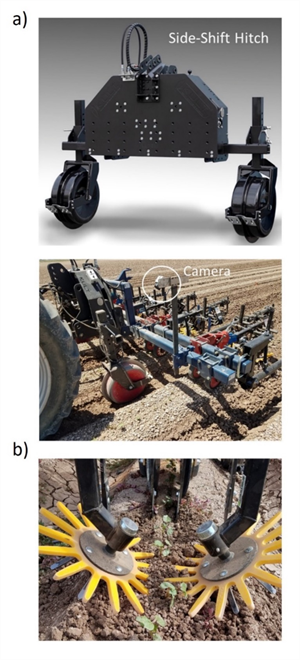
Fig. 1. Technologies for precision cultivation and in-row weeding
used in efficacy trials included a a) a camera-guided side-shift hitch
attached to a cultivator and b) in-row weeding tools (finger weeders).
Fig. 2. Click on image above to watch presentation on precision cultivation and in-row weeding technologies.
The SW Ag Summit is taking place in Yuma this week. We will have the Weed Control breakout session on Thursday, 22 February 2024 at 1:30 pm in room AS 115 of the AWC campus. Here’s what are we going to cover:
Do you know what the IR-4 Project is?
Established in 1963 by the U.S. Department of Agriculture and land-grant universities this project helps ensure that specialty crop farmers have legal access to safe and effective crop protection products and contributes to developing data necessary for the registration products for best pest management. Do we have this project in Yuma?
A Weed Scientist and Principal Biologist from IR-4 and NC State University will explain what this process of making more tools available to growers takes.
Additionally, we will have a representative from BASF chemical company who will present NEW WEED CONTROL TECHNOLOGIES as well as active ingredients developed by his company.
We all know with the loss of DCPA (Dacthal) herbicide our weed management tools were reduced. You asked the Veg IPM Team to look for ALTERNATIVES for Broccoli and Onion. We are doing some Trials at the UA Yuma Ag Center with products Such as Napropamide (Devrinol), which has the Devrinol DF XT dry formulation and the Devrinol 2-XT liquid.
Which one is more aggressive? How does water incorporation affect it? How good is it on goosefoot, lambsquarter, knotweed?
Other treatments we are looking at on broccoli are Goal Tender, Prefar, Prowl, Treflan, Enversa, Rinskor.
For direct seeded onion we are testing Prefar, Etothron SC, Dual, a combination of PREFAR+PROWL PREEMERGERGENCE at low rates, Outlook+Prowl.
We would like to share our observations if you honor us coming to our session. Again, it is TOMORROW Thursday, 22 February 2024 at the Arizona Western College AS 115 room. This session will start at 1:30 pm.
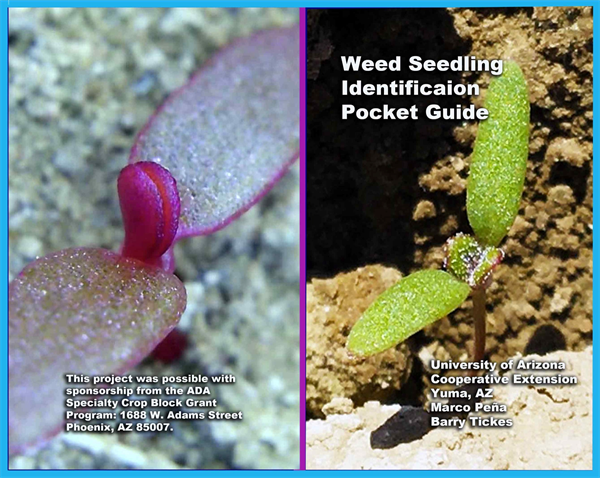
Get your free copy of the Weed Seedling Identification Pocket Guide at the Yuma Agricultural Center.
Biological control is one of the key tools for pest management in organic crop production. By maintaining permanent habitats and food sources for the pests’ natural enemies (good bugs) in the vicinity of your farms, you can ensure the continuous availability of the natural enemies. When the growing season starts, the good bugs will be readily available to attack the pests before they become established in the crops.
Researchers have found that planting a diversity of flowering plants (e.g., sweet alyssum, nasturtium, milkweeds, common cryptantha, hillside vervain, wild petunia, etc.) on a small portion of your farms or the farms’ border can provide adequate food and shelter allowing to maintain abundant and diverse natural enemy species, including syrphid flies, tachinid flies, lacewings, parasitic wasp, etc. that will attack aphids, thrips, lepidopterans, and more.
As you plan for the next season, please consider planting flowering plants on your farms’ borders or on dedicated patches to conserve natural enemies and enhance your biological control.


VegIPM Update Vol. 17, Num. 14
July 8, 2026
Results of trap catches below!!
Whitefly: Adult activity remains steady across locations; above average for this time of the year. Historically, whitefly numbers peak in July.
Thrips: Adult thrips activity decreased over the last two weeks. About average for this time of the year. Historically, thrips numbers remain low until Sept-Oct.
Diamondback Moth: No diamondback moths have been collected in the traps since May 19th. Based on the past six years summer collection data, no DBM is collected in the traps in the summer months (Jun-Aug) until September.