Justus von Liebig was a 19th century German scientist (1803-1873) who is regarded as one of founders of organic chemistry. He is also commonly considered as the “father of agricultural chemistry and the fertilizer industry.”
Liebig developed several important analytical methods used in a broad range of applications as well as many other important contributions and developments. Liebig was one of the great chemistry teachers of the 19th century that served as a foundation for the robust German chemical industry of the 20thand 21st centuries.
In 1840 Justus von Liebig presented a concept that is known as the “Law of the Minimum”, which was built upon a theory that had first been developed by Carl Sprengel, a German botanist (1787-1859). The Law of the Minimum basically states that a plant’s rate and extent of growth and overall health is dependent on the amount of the scarcest of the essential nutrients that are available to the plant (Figure 1; Liebig, 1840 and van der Ploeg et al., 1999).
The Law of the Minimum has been further applied into a general model of all organisms and biological functions, including the limiting effects of other environmental factors i.e., sunlight and water in terrestrial ecosystems, as well as excesses of nutrients and other environmental factors (Bruuselma and Nigon, 2023; Davidson, 2016; and Mosaic, 2023).
An important way to consider the Law of the Minimum is that the growth of plants, or crops, is not dependent on the total amount of nutrients available, but rather by the scarcest nutrient or resource (i.e., water). This is particularly important in relation to nutrients such as nitrogen, which is the nutrient required in largest amounts by plants, and it is the most common limiting plant nutrient. In desert agriculture, water is commonly the first most common limiting factor in plant growth and development, closely followed by bio-available nitrogen.
The Law of the Minimum is important to understand in managing fertilizer and other agronomic inputs to a crop. This has been demonstrated when fertilizer prices are high, particularly for nitrogen and phosphate fertilizers, and growers may be inclined to reduce or eliminate fertilizer applications.
Liebig’s Law of the Minimum is most applicable for nutrients and plant growth factors that are mobile in the soil. This is particularly relevant for nitrogen, which is available to plants in the nitrate form (NO3--N), which is mobile in the soil. Thus, (NO3--N) moves with soil-water.
Accordingly, the Liebig Law of the Minimum also pertains to water in a soil-plant system. Other growth factors or nutrients will not compensate for a deficiency in a given nutrient or plant growth factor. Plant-available nitrate-nitrogen (NO3--N) or water are good examples, there are no substitutes.
The Liebig Law of the Minimum is an important concept in soil fertility and plant nutrition and overall agronomic crop management in an irrigated production system.

Figure 1. Graphic illustration of the Law of the Minimum with shortest stave in
the barrel representing the most limiting nutrient in the soil-plant system.
References:
Bruulsema, T, and Nigon, L.L. Crops & Soils Magazine, November–December 2023 American Society of Agronomy. pp. 54-59.
Davidson, D. 2016. Nutrient Management Magazine.https://www.no-tillfarmer.com/articles/5648-no-till-notes-how-to-plan-your-summer-fertility-program?v=preview
Liebig, J. 1840. Die organische Chemie in ihrer Anwendung auf Agri- Sprengel, C. 1831. Chemie fu¨ r Landwirthe, Forstma¨nner und Cameralisten (Chemistry for agronomists, foresters, and agricultural econo-cultur und Physiologie (Organic chemistry in its applications to agri-culture and physiology). Friedrich Vieweg und Sohn Publ. Co., mists). Volume 1. Vandenhoeck und Ruprecht Publ. Co., Go¨ ttingen, Germany. Braunschweig, Germany.
Mosaic. 2023. How Law of the Minimum Impacts Crops' Nutrient Use. In: No-Till Farmer. https://www.notillfarmer.com/articles/12637-how-law-of-the-minimum-impacts-crops-nutrient-use
Vander Ploeg, A.R; Böhm, W.; and M. B. Kirkham. 1999. On the Origin of the Theory of Mineral Nutrition of Plants and the Law of the Minimum. Soil Sci. Soc. Am. J. 63:1055–1062.
First, I want to thank everyone who participated in last week's Vegetable Pest Losses Survey.
This year's survey included the return of the lettuce disease losses section. While several diseases were present and managed last season, downy mildew accounted for the majority of disease management costs by a wide margin. This really underscores the
impact that last spring's unusually rainy weather had on disease development across the Yuma lettuce production region.
No one can predict exactly what this upcoming spring will bring, but there has been discussion about the possibility of a strong El Niño leading to an extended monsoon season. If that proves true, the conditions would once again support spring
downy mildew development. The pathogen only needs about 3 to 4 hours of continuous leaf wetness to infect lettuce, so periods of overnight moisture, prolonged morning dew, or frequent rainfall when inoculum (spores) are present increase disease risk.
With that in mind, this seems like a good opportunity to review what is known about downy mildew and discuss strategies for its management.
Resistance in lettuce to Bremia lactucae, the causal oomycete pathogen behind downy mildew, is inherited in a gene-for-gene fashion, meaning one major gene product in the plant host interacts with one major gene product in the pathogen. When
resistance is present, this leads to an incompatible interaction between plant and pathogen and results in complete immunity to infection. Resistance genes in these types of interactions most often encode a protein molecule that acts like a burglar
alarm. These molecular sensors in the host bind to proteins secreted specifically by the pathogen, and when that happens a storm of defense responses is activated in the plant that excludes further infection. This is not the only mode of genetic resistance
found in plants, but it is often the most drastic and effective against obligate parasites like downy mildew.
But this simple gene-for-gene interaction often puts incredible selection pressure on the pathogen populations to change such that they can get around the resistance. By losing the molecule that the plant detects in order to initiate a defense response,
the pathogen becomes unrecognizable to the resistance genes a plant variety may have. Just like spraying the same mode of action over and over again leads to a pest population developing resistance to a pesticide, the same selection applies to genetic
resistance. The longer a resistance gene is deployed in a region, the more likely the pathogen population is to change in response until that resistance gene is no longer effective at managing the disease.
One of the biggest challenges with lettuce downy mildew is that B. lactucae is constantly changing over time. It exists as many different races, where each race has a different reaction to the resistance genes bred into lettuce varieties. You
can think of these races as different versions of the same pathogen. A lettuce variety that resists one race may still be susceptible to another.
These races are identified by testing them against a panel of lettuce varieties with known resistance genes. In the western United States, races are named by the International Bremia Evaluation Board-U.S. (IBEB-US) and are given names with a number followed by the country’s abbreviation, such as 8US, 9US, or 10US. The populations found in the western U.S. are different from those found in Europe, so each region uses its own independent naming system.
The downy mildew population has changed considerably over time. Earlier races (1US through 4US) are now rarely found in commercial lettuce production. During the 2000s and 2010s, races 5US through 8US became the most common. Race 9US was recognized after being detected repeatedly between 2015 and 2017, and the newest officially recognized race, 10US, was designated in 2025. Below is a pie chart showing the relative frequency of the races identified from 114 Yuma County downy mildew samples between 2023-2024:

Figure 1: Pathotyping results of 114 lettuce samples from Yuma County collected between 2023 and 2024. Data source: https://bremia.ucdavis.edu/bremia_database_main.php
The results show that much of the downy mildew population found in Yuma County is made up of novel strains of Bremia lactucae that have not yet been officially classified as a race. An official race is only recognized after it has been shown to be stable and widespread over multiple locations and growing seasons. These newer strains may disappear over time, or they may eventually become established and earn an official race designation. In the meantime, this means growers and lettuce breeders in Yuma County are often dealing with strains that can dodge the resistance in some lettuce varieties before those strains are common enough to be officially recognized. It also highlights why relying on resistance alone is not enough to manage the disease.
Table 1: Pathotyping and fungicide sensitivity results of samples from Yuma County collected in 2025.

This trend appears to be continuing. All of the downy mildew samples sent for race testing last season were identified as novel strains rather than known, officially designated races.
It's impossible to predict exactly how these new strains will respond to the resistance genes found in today's commercial lettuce varieties. However, because they have not been previously characterized, they are more likely to overcome existing genetic
resistance than the races we already know about.
New strains develop naturally over time. They can arise when different strains exchange genetics (i.e. intermate) or through random mutations. When growers plant varieties with similar resistance packages over large areas, the pathogen population
is placed under strong selection pressure. Any strain that happens to acquire the ability to infect those resistant varieties gains a major advantage and gets to reproduce without competition where other strains cannot. Over just a few disease
cycles, those successful strains can become much more common in the population until they are the predominant strain overall.
An important point to remember is that the resistance bred into commercial lettuce varieties is not wearing out or becoming weaker over time. The genetics in the lettuce remain just as effective as when the variety was released. What changes is the
pathogen. As the downy mildew population evolves new strains emerge that can bypass resistance genes that previously worked very well.
That means that varieties carrying resistance to races 5US through 10US are still doing exactly what they were designed to do. They continue to suppress those known races and help prevent them from becoming widespread in commercial fields. So, if
you experience significant downy mildew in a field planted with a variety that has a strong resistance package, the culprit is most likely one of these newer, uncharacterized strains rather than a failure of the variety itself.
Unfortunately, Bremia lactucae can evolve much faster than scientists can identify new races and breeders can develop and release resistant varieties. That's why no resistance package should be viewed as a stand-alone solution.
This is also why extension, researchers, and the seed and crop protection industries place so much emphasis on the integrated pest management (IPM) concept. Genetic resistance is an essential tool, but it works best and remains the most sustainable when combined with other management practices. For novel strains that can slip past host resistance, timely fungicide applications and other disease management strategies become especially important for maintaining control.

Figure 2: Mean disease severity by treatment. Disease severity was determined by rating 10 plants within each of the five replicate plots per treatment using the following rating system: 0 = no downy mildew present; 1 = downy mildew present on bottom leaves of plant; 2 = downy mildew present on bottom leaves and lower wrapper leaves; 3 = downy mildew present on bottom leaves and all wrapper leaves; 4 = downy mildew present on bottom leaves, wrapper leaves, and cap leaf; 5 = downy mildew present on entire plant. Disease severity is displayed as the mean of five replicates across all three lettuce varieties and bars show a 95% confidence interval around the mean calculated from individual treatment data. Compact letter display (CLD) above boxes show significantly different treatments (Kruskal-Wallis ANOVA and Dunn’s test). Boxes sharing the same letter(s) are not significantly different from one another. Fb = “followed by” in the rotation. Not all products are registered yet for use in lettuce. The inclusion of specific fungicide products or formulations in these trials does not constitute an endorsement or recommendation over other labeled products.
The most effective way to manage lettuce downy mildew is to use an integrated approach. Plant varieties with a strong resistance package against races 5US through 10US, and pair that resistance with timely, full-label-rate fungicide applications when environmental conditions favor disease. This combination provides the broadest and most reliable protection against both known races and the novel strains that continue to emerge in Yuma County.
If you have any concerns regarding the health of your plants/crops please consider submitting samples to the Yuma Plant Health Clinic for diagnostic service or booking a field visit with me:
Christopher Detranaltes, Ph.D.
Cooperative Extension – Yuma County
Email: cdetranaltes@arizona.edu
Cell: 602-689-7328
6425 W 8th St Yuma, Arizona 85364 – Room 109Last winter, we initiated two trials investigating the use of band-steam for controlling Sclerotinia lettuce drop and weeds in lettuce. Band-steam is where steam is used to heat narrow strips of soil to levels sufficient to kill soilborne pathogens and weeds (>140 °F for > 20 minutes). Trial results were promising and summarized in a pre-recorded presentation prepared for the 2021 ASABE Annual International Meeting. Highlights included finding that treatment with steam provided better than 85% weed control, and the unexpected result that crop yields were improved by more than 24% (Table 1). Energy requirements were high and treatment costs were more than $650/acre. We concluded that band-steam may be a viable technique for controlling soilborne pests in high value vegetable crops if the significant yield increases found in the study can be realized. For all the nitty gritty details and to see the presentation, click here or on the links below.
|
|
||||||
|
|
Weed |
Weed Control |
Hand Weeding |
Head |
Marketable |
Marketable |
|
Treatment |
(no. ac-1) |
(%) |
(hr ac-1) |
(lb head-1) |
(%) |
(lb ac-1) |
|
Band Steam |
9,148 b1 |
86 |
7.7 b |
1.60 a |
80 a |
32,909 a |
|
Non-treated |
65,713 a |
0 |
10.4 a |
1.46 b |
69 b |
26,521 b |
|
*Means within columns followed by the same letter are not significantly different according to Duncan’s New Multiple Range Test (P=0.10) |
||||||
Fig. 1. Click on the image to see a presentation on the development and
evaluation of a novel band-steam applicator for controlling soilborne pathogens
and weeds in lettuce.
The SW Ag Summit is taking place in Yuma this week. We will have the Weed Control breakout session on Thursday, 22 February 2024 at 1:30 pm in room AS 115 of the AWC campus. Here’s what are we going to cover:
Do you know what the IR-4 Project is?
Established in 1963 by the U.S. Department of Agriculture and land-grant universities this project helps ensure that specialty crop farmers have legal access to safe and effective crop protection products and contributes to developing data necessary for the registration products for best pest management. Do we have this project in Yuma?
A Weed Scientist and Principal Biologist from IR-4 and NC State University will explain what this process of making more tools available to growers takes.
Additionally, we will have a representative from BASF chemical company who will present NEW WEED CONTROL TECHNOLOGIES as well as active ingredients developed by his company.
We all know with the loss of DCPA (Dacthal) herbicide our weed management tools were reduced. You asked the Veg IPM Team to look for ALTERNATIVES for Broccoli and Onion. We are doing some Trials at the UA Yuma Ag Center with products Such as Napropamide (Devrinol), which has the Devrinol DF XT dry formulation and the Devrinol 2-XT liquid.
Which one is more aggressive? How does water incorporation affect it? How good is it on goosefoot, lambsquarter, knotweed?
Other treatments we are looking at on broccoli are Goal Tender, Prefar, Prowl, Treflan, Enversa, Rinskor.
For direct seeded onion we are testing Prefar, Etothron SC, Dual, a combination of PREFAR+PROWL PREEMERGERGENCE at low rates, Outlook+Prowl.
We would like to share our observations if you honor us coming to our session. Again, it is TOMORROW Thursday, 22 February 2024 at the Arizona Western College AS 115 room. This session will start at 1:30 pm.
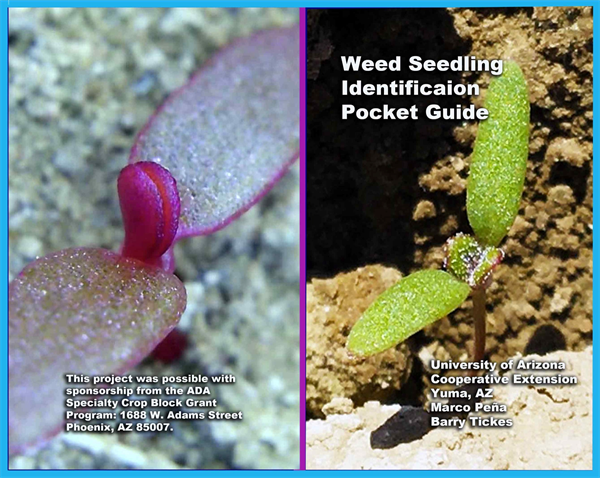
Get your free copy of the Weed Seedling Identification Pocket Guide at the Yuma Agricultural Center.
Biological control is one of the key tools for pest management in organic crop production. By maintaining permanent habitats and food sources for the pests’ natural enemies (good bugs) in the vicinity of your farms, you can ensure the continuous availability of the natural enemies. When the growing season starts, the good bugs will be readily available to attack the pests before they become established in the crops.
Researchers have found that planting a diversity of flowering plants (e.g., sweet alyssum, nasturtium, milkweeds, common cryptantha, hillside vervain, wild petunia, etc.) on a small portion of your farms or the farms’ border can provide adequate food and shelter allowing to maintain abundant and diverse natural enemy species, including syrphid flies, tachinid flies, lacewings, parasitic wasp, etc. that will attack aphids, thrips, lepidopterans, and more.
As you plan for the next season, please consider planting flowering plants on your farms’ borders or on dedicated patches to conserve natural enemies and enhance your biological control.


VegIPM Update Vol. 17, Num. 15
July 22, 2026
Results of trap catches below!!
Whitefly: Adult activity remains steady across locations; above average for this time of the year, especially high numbers seen in North Gila Valley. Historically, whitefly numbers peak in July.
Thrips: Adult thrips activity remained low over the last two weeks. About average for this time of the year. Historically, thrips numbers remain low until Sept-Oct.