-
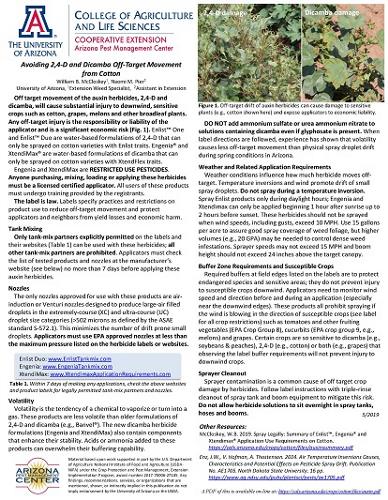 May 2019Off target movement of the auxin herbicides, 2,4-D and dicamba, will cause substantial injury to downwind, sensitive crops such as cotton, grapes, melons and other broadleaf plants. This publication provides guidelines for preventing off target movement.
 -
 May 2019
Blister beetles produce a toxic compound called cantharidin, which can be lethal to horses and unpleasant to humans and other animals. This publication provides guidelines to help growers avoid blister beetle contamination.
-
 May 2019Spray Legally: Summary of Enlist™, Engenia® and Xtendimax® Application Use Requirements on Cotton (PDF, 1 MB)This publication summarizes best use practices and label requirements for auxin herbicides.
 -
 May 2019A guide to recognizing Arizona’s diverse blister beetles and how to distinguish them from other similar beetle species.
 -
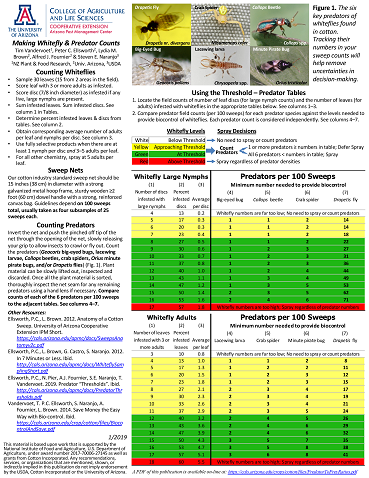 Jan 2019This guide provides instructions for sampling both whiteflies and their predators, to aid in whitefly spray decisions which factor in the influence of key predators on suppressing whitefly population growth. Tables indicate when predator levels are sufficient to defer a whitefly spray, or alternately, to advance a spray ahead of threshold, based on a scientific understanding of how predator levels impact whitefly population growth.
 -
 Jan 2019Understanding levels of key predators in the field can help you make more confident whitefly spray decisions. New research has identified critical levels of predators that impact economic spray decisions for whiteflies. By monitoring the number of key predators in the field when whiteflies are at or approaching standard whitefly thresholds, pest managers may confidently defer sprays, or alternately, may wish to advance a spray prior to reaching threshold, based on predator population levels.
 -
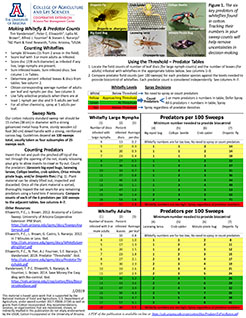 Jan 2019Biological control can be incorporated into whitefly management by sampling 4 key predators and comparing them to whitefly populations. High ratios of predators to whiteflies indicate control and may defer a control spray. Low ratios indicate a lack of control and may advance a whitefly spray.
 -
 Oct 2018Three important things to remember regarding head lice in schools: 1) In any school classroom 1% head lice incidence is normal. 2) If classrooms report >20% infestation levels, it is likely to be a misdiagnosed head lice infestation. 3) No pesticide treatment of a classroom, school bus or home is ever necessary or beneficial.
 -
 Sep 2018Personal repellents applied to skin, clothing, or other surfaces help to repel ticks, mosquitoes and other biting flies that feed on people.
 -
 Aug 2018The longhorned tick, Haemaphysalis longicornis, also known as Asian longhorned tick, cattle tick or bush tick, native to East Asia, is a recent invasive tick species in the United States. It is important to be on the lookout for this tick in Arizona.
 -
d726e4b5838c4e258908ac21d4d90c2b.png?sfvrsn=753dc26e_0?size=300) Jun 2018The Agricultural Handlers Exposure Task Force (AHETF) discovered some improper practices that caused unnecessary exposure to mixer/loaders using Water Soluble Packaging (WSP). The AHETF reported their findings and presented the EPA with a list of best management practices to help minimize exposure caused by these improper practices.
Jun 2018The Agricultural Handlers Exposure Task Force (AHETF) discovered some improper practices that caused unnecessary exposure to mixer/loaders using Water Soluble Packaging (WSP). The AHETF reported their findings and presented the EPA with a list of best management practices to help minimize exposure caused by these improper practices. -
 Jan 2018Summer brings a lot of insect activity, and many people experience bites. Some of these are from insects that can be seen, for example, mosquitoes. However, sometimes all that can be seen are the bites, leaving the affected persons wondering what bit them.
 -
 Aug 2017Tick and flea collars are long-term pest control products for your pets. They kill pests or deter them from living and feeding on your pets. Some products last for 3 months, while others are effective for 8 months. The chemistries in these collars are designed to work on pests while reducing the possibility of negative side effects for you and your pets. But, exposure to these ingredients can be hazardous.
 -
 Aug 2017Phosphorus is the primary mineral nutrient likely to be required by an alfalfa crop in Arizona. A single application of phosphorus fertilizer at planting time may be sufficient for the life of the stand in certain situations. However, on soils with a high phosphorus fixing capacity, a single application of phosphorus fertilizer at planting time may not be sufficient.
 -
 Aug 2017Four organic insecticides were recently found to be contaminated with several synthetic insecticides by the Oregon Department of Agriculture (ODA). ODA is now working to identify the source of contamination for these insecticides.
 -
 Jun 2017Off target movement of 2,4-D and dicamba can cause substantial injury to downwind sensitive plants, a potential liability issue for applicators. This short outlines herbicide label requirements and best practices to prevent drift of auxin herbicides.
 -
 Jun 2016Chemical Use Maps available to PCAs on a secure website show where whitefly insecticides (6 modes of action) were used in the previous year, at the section level. PCAs and growers can view previous use in sections surrounding their fields to help guide insecticide choices for whitefly management this year. These maps can be a tool to help put first principles of resistance management to work.
 -
 Jun 2016Accurate data on agricultural pesticide use in Arizona has many uses that benefit grower communities. The accuracy of pesticide use data impacts the quality of UA outreach, publications and reports. This short provides tips and resources to help improve data quality.
 -
 Jun 2016Conenose bugs belong in the insect Order Hemiptera, Family Reduviidae, commonly called assassin bugs because most members of this family are predators of other arthropods and are in fact beneficial. Conenose bugs are an exception to the family rule and are blood-feeding parasites that feed on a wide variety of domestic and wild animals, and occasionally humans.
 -
 Apr 2016The term ‘bee’ can refer to many insects belonging to different families under the insect order Hymenoptera. Bees are closely related to ants and wasps.