The Yuma agriculture community lost a legend with the passing of our friend and colleague, Vicki-Lynne Scott. Vicki was a friend to everyone she met and a mentor to countless people across our agricultural community, leaving a lasting impact on Yuma agriculture and University of Arizona Extension.
I was especially fortunate to work closely with Vicki these past few months as she brought me into conversations surrounding the diamondback moth challenges facing our vegetable systems. She believed in me as an entomologist and had confidence in my abilities before I fully recognized them myself. She cared deeply about helping growers and making sure the right people were at the table to move our industry forward. Vicki also loved the Veg IPM Newsletter and often referenced Dr. Jeff Silvertooth’s work and the value of University of Arizona Extension programs.
As our community moves forward, it is difficult to imagine facing these agricultural challenges without Vicki’s guidance. Her legacy will live on in the countless people she mentored and supported throughout her life.
Vicki never left any of us wondering how deeply she cared about the people and community around her. Thank you, Vicki, for believing in people, bringing us together, and leaving our agricultural community better than you found it.
As reductions of agricultural water allocations in central Arizona from the Colorado River are going into place in 2022 from the Tier 1 of the Drought Contingency Plan provisions, it is important for every segment of the Arizona agricultural industry to continue to review and refine our practices associated with water management and irrigation.
Seasonal conditions are a benefit to vegetable crop production and water management in the desert Southwest, both in terms of cool-season crop adaptability and the general climatic conditions that create lower environmental crop water-use demands. For example, based on more than 30 years of Arizona Meteorological Network (AZMET) data from the Yuma, Arizona area, approximately 20% of the total annual reference evapotranspiration demand typically occurs between August and May.
Reference evapotranspiration (ETo) is the collective loss of water from a field due to evaporation from the soil surface and transpiration of water vapor from the plants. Collectively, water movement from the soil and plant systems in a field is referred to as “crop consumptive use” and it is important to understand this process in our efforts to steward our water resources most effectively.
The AZMET system provides both historical and real-time weather information that can be used to assist in crop water and irrigation management. Reference evapotranspiration values can be obtained daily from AZMET for the Yuma area and applicable to most of the region in the lower Colorado River Valley. The ETo values multiplied by an appropriate crop coefficient (Kc) can provide very good estimates on actual crop evapotranspiration (ETc) rates, ETo * Kc = ETc.
The appropriate Kc values are specific for each crop species and stage of growth. We commonly use crop coefficient Kcvalues that are provided in the publication “Consumptive Use by Major Crops in the Desert Southwest” by Dr. Leonard Erie and his colleagues, USDA-ARS Conservation Research Report No. 29 (see attached). Reference information for Kcvalues can be obtained in this publication for common vegetable crops grown in this region.
Estimating and tracking actual crop-water use can be a valuable tool in understanding crop-water demand and irrigation management. Comparing actual crop-water demand and crop irrigation practices can be important in our efforts to understand crop management needs and field-level efficiencies.
Reference:
Erie, L.J., O.A French, D.A. Bucks, and K. Harris. 1981. Consumptive Use of Water by Major Crops in the Southwestern United States. United States Department of Agriculture, Conservation Research Report No. 29.
It’s been anything but a smooth Spring melon season this year. Mild winter temperatures have contributed to the persistence of weeds and whitefly populations culminating in high viral pressure observed from the very first melon plantings onward. Through a collaborative effort between the University of California, USDA, and University of Arizona we would like to invite growers, PCAs, farm managers, researchers, and other stakeholders from the desert melon production regions in California, Arizona, and Mexicali to join us for a stakeholder meeting to discuss field observations and disease management research priorities.
This meeting will provide an opportunity to review this season’s observations and trends across production areas, hear research and strategy updates from plant pathology specialists, and, most importantly, create space for discussion among stakeholders to better understand what is happening and give input on the disease management research priorities you want to see pursued moving forward. Topics and invited speakers include:
Bill Wintermantel (USDA-ARS) – Overview of cucurbit viruses affecting desert melon production
Arun Babu (UCCE Imperial)– Whitefly populations and insecticide efficacy trials in Imperial Valley
Samuel Discua (University of Arizona, Yuma) – Whitefly populations and insecticide efficacy trials in Yuma, Arizona
Chris Detranaltes (University of Arizona, Yuma)– Viruses and other pathogens recovered from symptomatic melon plants in Yuma, Arizona
Ana M. Pastrana (UCCE Imperial) – Viruses and other pathogens recovered from symptomatic melon plants in Imperial Valley, California
Lunch will be provided. Please register here if you plan to attend so we can have an accurate food count and seating estimate: Registration Survey
If you have any concerns regarding the health of your plants/crops please consider submitting samples to the Yuma Plant Health Clinic for diagnostic service or booking a field visit with me:
Christopher Detranaltes, Ph.D. Cooperative Extension – Yuma County
Email: cdetranaltes@arizona.edu
Cell: 602-689-7328
6425 W 8th St Yuma, Arizona 85364 – Room 109
Controlling Disease and Weeds with Band-Steam – Yuma Trials Show Good Promise
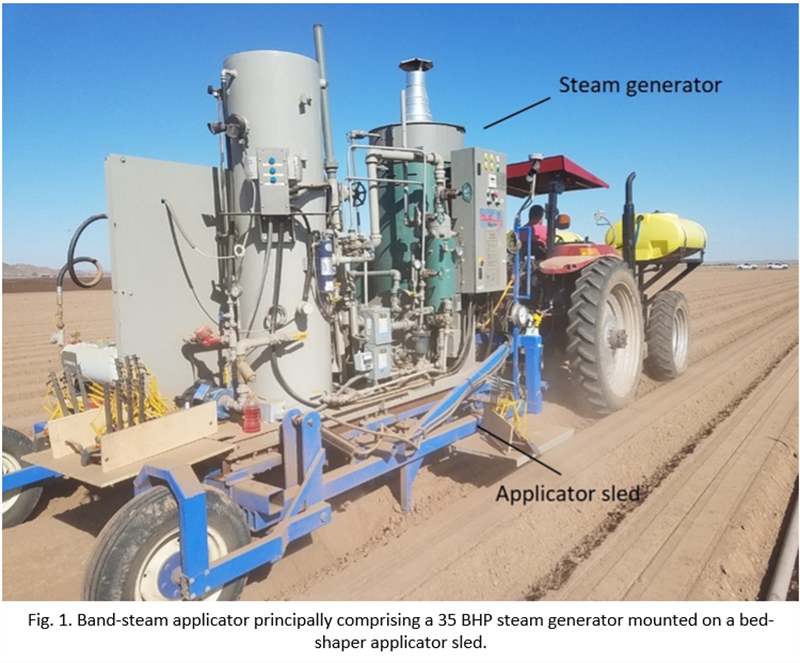
In previous articles (Vol. 11 (13), Vol. 11 (20), Vol. 11(24)), I’ve discussed using band-steam to control plant diseases and weeds. Band-steaming is where steam is used to heat narrow strips of soil to temperature levels sufficient to kill soilborne pathogens and weed seed (>140 °F for > 20 minutes). The concept is showing good promise. This past season, three trials were conducted examining the efficacy of using steam for disease and weed control in Yuma, AZ. In the studies, steam was applied in a 4-inch-wide by 2-inch-deep band of soil centered on the seedline using a prototype band-steam applicator (Fig.1). The band-steam applicator is principally comprised of a 35 BHP steam generator mounted on top of an elongated bed shaper. The apparatus applies steam via shank injection and from cone shaped ports on top of the bed shaper.
Trial results were very encouraging as the prototype applicator was able to raise soil temperatures to target levels (140°F for >20 minutes) at viable travels speeds of 0.75 mph. Steam provided better than 80% weed control and significantly lowered hand weeding time by more than 2 hours per acre (Table 1). Results also showed that Fusarium colony forming units (CFU) were reduced from 2,600 in the control to 155 in the 0.75 mph and 53 in the 0.5 mph treatments, respectively (a more than 15-fold reduction). A significant difference in Fusarium wilt of lettuce disease incidence was not found, however disease infection at the field site was low (< 2%) and differences were not expected. At 0.5 mph, fuel costs were calculated to be $238/acre which was considered reasonable and consistent with the values reported by Fennimore et al. (2014).
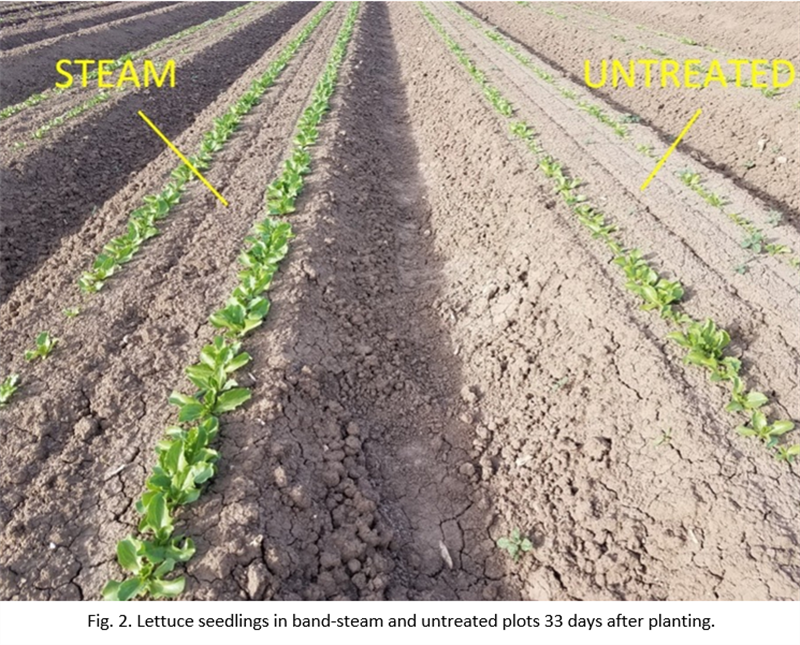
An unexpected finding was that plants in steam treated plots appeared to be healthier and more vigorous than untreated plots (Fig. 2). This trial is still in progress and it will be interesting to see if this improved early growth translates into increases in crop yield.
In summary, early trial results are showing good promise for use of band-steam as a non-herbicidal method of pest control. We plan on conducting further trials in this multi-year study. If you are interested in evaluating the device on your farm and being part of the study please contact me. We are particularly interested in fields with a known history of Fusarium wilt of lettuce and/or Sclerotinia lettuce drop that will be planted to iceberg or romaine lettuce.
As always, if you are interested in seeing the machine operate or would like more information, please feel free to contact me.
Acknowledgements
This work is supported by Crop Protection and Pest Management grant no. 2017-70006-27273/project accession no. 1014065 from the USDA National Institute of Food and Agriculture, the Arizona Specialty Crop Block Grant Program and the Arizona Iceberg Lettuce Research Council. We greatly appreciate their support. Any opinions, findings, conclusions, or recommendations expressed in this publication are those of the author(s) and do not necessarily reflect the view of the U.S. Department of Agriculture.
A special thank you is extended to Mellon Farms for allowing us to conduct this research on their farm.
References
Fennimore, S.A., Martin, F.N., Miller, T.C., Broome, J.C., Dorn, N. and Greene, I. 2014. Evaluation of a mobile steam applicator for soil disinfestation in California strawberry. HortScience 49(12):1542-1549.
Click link below or picture to see the band-steam and co-product applicator in action!
Malva (malva parviflora) is one of the oldest and most pervasive weeds that that we deal with here. It is also known as little mallow or cheeseweed and is in the same family as cotton, okra and hibiscus. It is often classified as a winter annual but survives all year in this region. It has a deep taproot and can grow in compacted clay or sand and in freezing conditions and high temperatures It provides a refuge for insects and diseases that can damage several crops.
Malva is easy to identify both as a seedling and mature plant. The seedlings are distinctively heart shaped and the mature plant is broad and palm shaped. It is very vegetative and can grow to 6 ft.
The deep tap root of this weed makes it difficult to cut out after it is established. Its response to herbicides id somewhat unusual. It is very sensitive to contact herbicides that do not move into the plant. These include Goal, Sharpen Gramoxone , Rely,Aim and others. However, it is not sensitive to systemic herbicides like 2,4-D and Glyphosate. It reproduces from seed and can be controlled preemergence with many of the same preemergence herbicides used in cotton like Prowl or Treflan. The seed pods are wheel shaped which is where the name cheeseweed comes from. Each seed pod contains 10 to 12 seeds
Whitefly: Adult activity continues to increase across locations, yet these numbers do not reflect what we are seeing in the field on melon insecticide efficacy trials at YAC, numbers for untreated plots and melon virus incidence are well above what we have seen in other years. Historically whitefly numbers peak in July.
Thrips: Adult thrips activity remained steady across locations over the last two weeks. Historically, western flower thrips numbers peak in May.