The Yuma agriculture community lost a legend with the passing of our friend and colleague, Vicki-Lynne Scott. Vicki was a friend to everyone she met and a mentor to countless people across our agricultural community, leaving a lasting impact on Yuma agriculture and University of Arizona Extension.
I was especially fortunate to work closely with Vicki these past few months as she brought me into conversations surrounding the diamondback moth challenges facing our vegetable systems. She believed in me as an entomologist and had confidence in my abilities before I fully recognized them myself. She cared deeply about helping growers and making sure the right people were at the table to move our industry forward. Vicki also loved the Veg IPM Newsletter and often referenced Dr. Jeff Silvertooth’s work and the value of University of Arizona Extension programs.
As our community moves forward, it is difficult to imagine facing these agricultural challenges without Vicki’s guidance. Her legacy will live on in the countless people she mentored and supported throughout her life.
Vicki never left any of us wondering how deeply she cared about the people and community around her. Thank you, Vicki, for believing in people, bringing us together, and leaving our agricultural community better than you found it.
It’s been anything but a smooth Spring melon season this year. Mild winter temperatures have contributed to the persistence of weeds and whitefly populations culminating in high viral pressure observed from the very first melon plantings onward. Through a collaborative effort between the University of California, USDA, and University of Arizona we would like to invite growers, PCAs, farm managers, researchers, and other stakeholders from the desert melon production regions in California, Arizona, and Mexicali to join us for a stakeholder meeting to discuss field observations and disease management research priorities.
This meeting will provide an opportunity to review this season’s observations and trends across production areas, hear research and strategy updates from plant pathology specialists, and, most importantly, create space for discussion among stakeholders to better understand what is happening and give input on the disease management research priorities you want to see pursued moving forward. Topics and invited speakers include:
Bill Wintermantel (USDA-ARS) – Overview of cucurbit viruses affecting desert melon production
Arun Babu (UCCE Imperial)– Whitefly populations and insecticide efficacy trials in Imperial Valley
Samuel Discua (University of Arizona, Yuma) – Whitefly populations and insecticide efficacy trials in Yuma, Arizona
Chris Detranaltes (University of Arizona, Yuma)– Viruses and other pathogens recovered from symptomatic melon plants in Yuma, Arizona
Ana M. Pastrana (UCCE Imperial) – Viruses and other pathogens recovered from symptomatic melon plants in Imperial Valley, California
Lunch will be provided. Please register here if you plan to attend so we can have an accurate food count and seating estimate: Registration Survey
If you have any concerns regarding the health of your plants/crops please consider submitting samples to the Yuma Plant Health Clinic for diagnostic service or booking a field visit with me:
Christopher Detranaltes, Ph.D. Cooperative Extension – Yuma County
Email: cdetranaltes@arizona.edu
Cell: 602-689-7328
6425 W 8th St Yuma, Arizona 85364 – Room 109
Band-Steam Applicator for Controlling Soilborne Pathogens and Weeds in Lettuce
Steam sterilization of soils is commonly used in plant nurseries and greenhouses for effective control of soilborne pathogens and weed seeds. The technique, however, is highly energy intensive as the entire soil profile is heated. This is too costly and slow to be practical for field scale vegetable production. To reduce energy consumption and cost, use of band-steaming, where steam is applied only in the area where it is needed – in the plant root zone, is proposed. In this method, narrow strips of soil centered on the seed line are treated with steam rather than the whole bed.
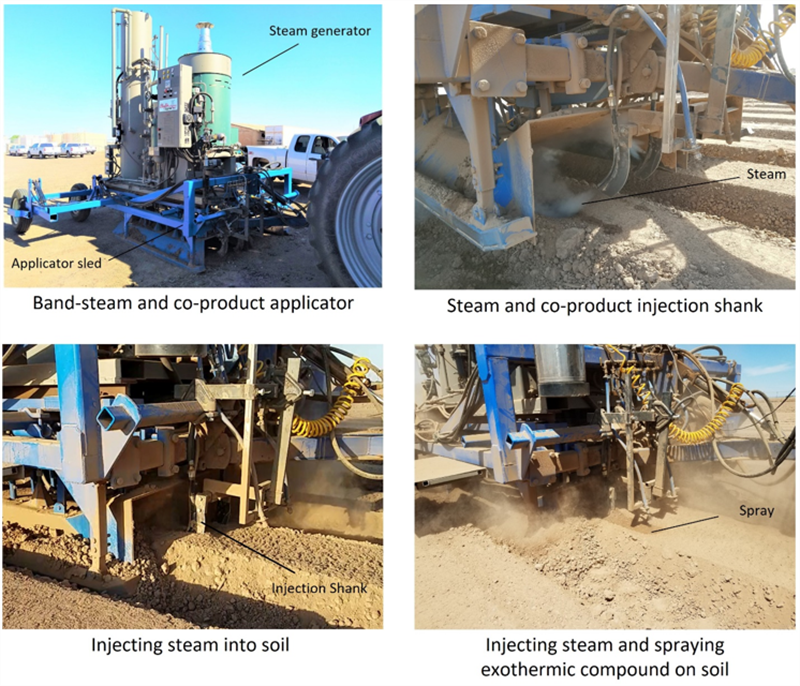
Over the course of the last year, we developed a prototype band-steam and co-product applicator that is designed to raise soil temperatures in a band 2” deep by 4” wide to levels sufficient to control soilborne pathogens (140 °F for > 20 minutes) and weed seed (150 °F for > 20 minutes). The device is principally comprised of a 35 BHP steam generator and a co-product applicator mounted on top of a bed shaper (Fig.1). The apparatus applies steam via shank injection and from cone shaped ports on top of the bed shaper. An exothermic compound can be co-applied via shank injection and/or a banding spray nozzle. The rationale behind co-applying an exothermic compound with steam is that exothermic compounds react and release heat when combined with water, thereby reducing energy requirements and increasing travel speed.
Preliminary testing of the device this spring in Yuma, AZ were very promising. Trial results showed that application of steam alone effectively raised soil temperature in the center of the seed line to levels required for effective pest control (140 °F for more than 20 minutes). Use of the exothermic compound increased soil temperature by about 10 °F. A video of the device in action can be found at the link provided below.
We are currently evaluating the device in field trials with lettuce in Salinas, CA. Target pests in these experiments conducted in collaboration with Steve Fennimore, UC Davis, are soil pathogens which cause Sclerotinia lettuce drop and in-row weeds. Future articles will report the findings of this research.
This fall, we will be replicating these tests in Yuma, AZ and also investigating the effectiveness of band-steam for controlling Fusarium oxysporum f. sp. lactucae which causes Fusarium wilt of lettuce. Heat has been shown to effectively kill Fusarium oxysporum spores and control Fusarium wilt disease. As an example, soil solarization, where clear plastic is placed over crop beds during the summer, raises soil temperatures to 150-155˚F at the soil surface, effectively killing the pathogen and reducing disease incidence by 45-98% (Matheron and Porchas, 2010).
These projects are sponsored by USDA-NIFA, the Arizona Specialty Crop Block Grant Program and the Arizona Iceberg Lettuce Research Council. We greatly appreciate their support.
If you are interested in seeing the machine operate or would like more information, please feel free to contact me.
See the band-steam and co-product applicator in action!
References:
Matheron, M. E., & Porchas, M. 2010. Evaluation of soil solarization and flooding as management tools for Fusarium wilt of lettuce. Plant Dis. 94:1323-1328.
Managing Water with Preemergence Herbicides in Lettuce
We are always adjusting how we use herbicides to fit the unique conditions in this area. The herbicides that are registered for use on lettuce here are limited and they all require a little different management. Environmental conditions, soil characteristics and Chemical properties all can greatly affect how well the 3 preemergence herbicides used in lettuce will work. These include Balan, Prefar and Kerb. Environmental conditions and soil characteristic vary greatly from year to year and field to field. It is difficult to make general recommendations on how best to use these three herbicides because of this. Chemical characteristics do not vary, however, and we can make some generalizations on how they should be used.
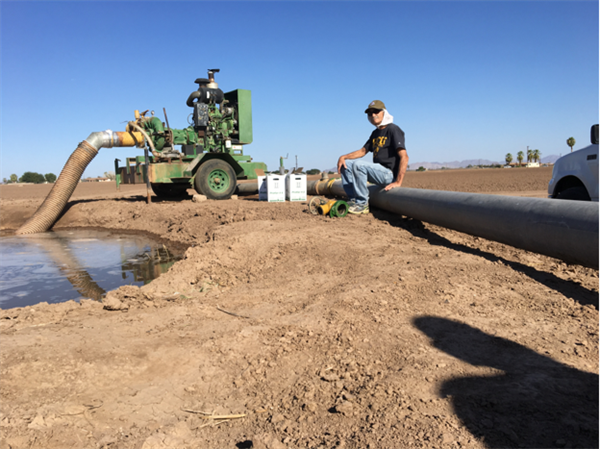
We use a lot of water here during stand establishment and at this time of year. The water solubility of Balan, Prefar and Kerb vary widely and should be considered when deciding how to use them. Water solubility is the amount of the herbicide that will dissolve in water. This is usually given as PPM or mg/liter. The higher the number the more soluble it is. Solubility will effect leaching into the soil and runoff. The solubility of Balan is 0.1 PPM,Prefar is 5.6 PPM and Kerb is 15 PPM. What this means is that Balan is very insoluble and has to be mechanically incorporated. Prefar is 56 times more soluble than Balan and can be incorporated with overhead water but this is still not a very soluble herbicide and a lot of water is needed. Kerb is 150 times more soluble than Balan and almost 3 times more soluble than Prefar. Kerb will leach and the amount of overhead water applied must be carefully managed.
Area wide Insect Trapping Network (February 18, 2026)
VegIPM Update Vol. 17, Num. 4 Feb. 18, 2026
Results of pheromone and sticky trap catches below!!
Corn earworm: CEW moth beginning to increase in some areas, particularly in Wellton and Tacna in the past week; About average for this time of season.
Beet armyworm: BAW numbers continue to increase across most locations over the last two weeks. Above average for this time of the season.
Cabbage looper: Cabbage looper moth activity continued to increase over the last two weeks at most locations and above average for mid-February. Historically cabbage looper moth numbers peak in March/April.
Diamondback moth: Adult activity increased across most locations. About average for this time of the year.
Whitefly: Adult activity remains low across all locations, about average for this time of year.
Thrips: Thrips adult activity started to increase across locations, about average for this time of year. Expect numbers to continue increasing as temperatures warm up.
Aphids: Winged aphid numbers increased rapidly over the last two weeks; below average for this time of the year. Aphid numbers typically peak around mid-February.
Leafminers: Adult leafminer activity increased over the last two weeks particularly in Yuma Valley, about average for this time of the season.
 To contact Macey Wildermuth go to: maceyw@arizona.edu